

SWC Forums
Pull up a chair...let's talk fishing.

I have to say that I have had a Tow Boat US Membership for over 14 years. I have had to use their towing services on many occasions: Spun propeller hub (before I carried spare props), engine fire, failed ignition, etc.
John from Tow Boat US Southport has NEVER let me down. I recall in 1998 or 1999 he went out to assist a vessel in documented 70mph wind gusts.
I don't know why he couldn't come and get you 40 miles out, but I'm certain he had a legitimate reason.

Tow Boat US has rescued me 40+ miles offshore before. They will come get you unless there are extenuating circumstances. Once I broke down 46 miles offshore, towboat broke down coming to get me, and USCG stepped in before another towboat franchise could be dispatched. I would not be blaming towboat here as far as I understand the facts. Since towboat could not get the vhf call, coast guard was relaying the communications and may have stepped in before another franchise was contacted. That is precisely what happened with me.
The coast guard tow is free to boat owner. Our taxes pay for the USCG fuel. Glad the coasties are their to bail us out :wtg:
There had to be a good explanation. I am very pleased with Towboat so far.
Glad you and your crew are back safe and the rig will be running again soon.
I started this thread so that others could perhaps learn from our ordeal --including mistakes that I'm sure I made. That makes me vulnerable to both constructive and destructive advice from those who have participated in the discussion, but that's part of why we participate on this board. We all keep learning. It's one of the reasons some of us go through the training and examination process to earn Coast Guard captains' credentials. Not so we can run charters, but simply to be more knowledgeable and prepared when things go south in a hurry. Much of the advice we've seen posted here has been helpful to me and hopefully to others. When our steering went out we went over every detail of the manuals for the boat, the engines, and the hydraulic system. We tried tape, clamps, adding hydraulic fluid, steering with the engines and tabs, and every other damned thing we could think of to patch the ruptured hydraulic line and to steer the boat after the manuals basically told us, "You're f***ed".
Our VHS worked perfectly. It troubles me a bit that Coast Guard Oak Island had to have heard, but did not respond at all, to our several initial distress calls. Only the NOAA vessel did, and that was from thirty miles away in a different direction. CGOI had to have heard those calls and my communications with the NOAA vessel while we were on Channel 16. My first request was for the helpful NOAA lieutenant to contact Tow Boat US, and ask if they could come to our assistance and call our families that we were going to be home late. When he relayed the message to me that "equipment issues" prevented Tow Boat/US from coming out, I asked him to contact the Coast Guard for me. Hours later, the NOAA ship (which remained on station while we were sorting things out) told me the good news that a CG vessel would be launched and should reach us in three hours. I then decided to try to hail CG Oak Island directly for clarification. They responded immediately, confirming that I was coming in loud and clear and that they would let me know when their vessel was launched. It would have been much simpler if CGOI simply had responded to my earlier distress calls.
At that point, they began sending out vessel in distress announcements three hours after my initial requests. But I'm not complaining a bit about any of that. I'm immensely grateful that they ultimately responded. They determined that the Coast Guard's charter from Congress and the service's own internal regulations called for them to render assistance under the conditions they saw developing.I'm responsible for the lives and safety of those aboard my boat, and I will never shy away from or apologize for doing everything I possibly can to make that happen. No, the Coast Guard is not, and should not be, in the boat towing business. That's why prudent boaters pay for unlimited towing from private companies as I and many others here do. The Coast Guard was, and should be, a last resort. And that's what they were in this case. But protection of life and property is one the reasons they exist. I learned today that I may not receive a bill from the Coast Guard. If I do, I'll pay it gladly. When I made the distress calls, I expected to cover whatever costs the agency incurred. That didn't matter to me. My job was to get my guys to safety, and I was relieved that my need for assistance and the Coast Guard's charter role in marine safety came together to produce the result we needed. This was never about a boat tow. It was a matter of safety.
Thanks to some of the advice written here, I bought a SAT phone this morning. I've added several items to my ditch bag that might have helped us Monday. I'm arranging for a complete survey of the boat to see if there are other mechanical issues that might be discovered before they happen. I'm sure I'll make other adjustments. My two recent mishaps -- this one and a shattered windshield a couple of weeks ago -- provided chances for others maybe to learn from this without having to go through similar situations themselves. Thanks to all who provided constructive suggestions and advice.

good work. way to get everyone home safely. Fish another day.
Just ordered that rescue tape
Twin outboards - disconnect hydraulic steering cylinder from motor mount. If the tie bar is still in place good, both engines stay aligned. Attach your boat hook, brush, gaff, etc. to the tie bar or steering arm on a motor. Make a pivot point forward of the motors for the makeshift tiller handle. This could be with ropes to side cleats or to rods stuck in rear rod holders. Lots of boats have rod holders in the middle of the euro transome, stick a rod in there and rope your tiller around that for your pivot point. If your gaff (tiller handle) is 6' long and your pivot pint is 2' ahead of the motors then you will have a mechanical advantage and should be able to steer easily (altough maybe only at slow speed).
If motors can't be linked then rig one motor and tilt the other out of the
way.
Some outboards have 2 holes in the steering arm. Move the tie bar to the inner hole if necessary and gaff the outer hole. Make your pivot point as described above and troll in.
------------------------------------------------
On I/O's - If necessary take the hoses off the hydraulic cylinder behind the engine. Tie 2 ropes to the anti cav plate just above the prop. Pull each rope forward and to the side and go around a rear cleat. Pull one rope and let off on the other to steer one direction and do the opposite to steer the other direction.
Do these 2 methods make sense?
Glad you got in safe.
Lots to learn here.
More items for the tool kit.
(I am going to need a bigger boat)
not sure what i did on my earlier post.
what sat phone did you end up with if you don't mind sharing? i have been researching them as well. lot of sat capable services out there but not many seem like feasible/useful for offshore boating.
I just received this from Tow Boat US:
Thank you for taking the time to e-mail BoatU.S. Towing Services.
I spoke with the tow captain who was involved. He had an extremely busy Memorial Day weekend and took the boat down for maintenance that was going to take a couple of hours. He received the relayed call. He said and it would have taken up to three hours to get the BoatU.S. Member, once he was back on the water and he felt, with weather building and night approaching, that it would be quicker and safer to ask the Coast Guard to go get the boater and he would rendezvous with them once he was running and take the BoatU.S. Member in the rest of the way.
I am think this makes sense to me. Still some questions as to why oldcabdriver had to relay info via the NOAA ship.
I own a Pursuit '34 with twin Yamaha 350's and last summer blew a compression fitting on the hydraulic line to my auto pilot pump, i.e. no steering. We disconnected the hydraulic line so that the motors would move freely and found that the faster we ran the more the engines stayed in line. We then used the throttles to steer the boat and brought it from 53 miles out to Radio Island and backed it into the slip. We ran 25 to 30 all the way back in 3-6' seas and occasionally the wheels would run off and we would have to stop and get the engines back in line and speed up again. Forget trying to fix a compressions fitting without all the tools. There is no reason that the engines would lock up if you take the pressure out of the lines.

I have lost steering offshore on a Grady CC. I was only 6 miles out in good conditions when it happened. A seal on the cylinder gave away. Here is what I learned after the fact during the tow in:
1. Eliminate all pressure by loosening all fittings. You lose pressure on one side and it kicks over. I had twins as well. Dumping pressure allowed me to straighten the engines.
2. Use rope onboard (you have plenty) to tie the engines off to either side of the boat. Now when they torque, they stay straight.
3. You can now apply throttle and the engines are constrained to stay straight, so you can steer with throttles and tabs.
Of course I figured this out under ZERO duress while happily watching the Seatow boat pull me. I simply got to the dock faster by pushing while he pulled.

Hey Guys....that really sucks but glad everybody got home safe. I've read this entire post and I was wondering if one of you guys could tell me where on this picture I would attach a gaf to steer the motors after I have taped them together if I were to lose steering. I appreciate any suggestions.....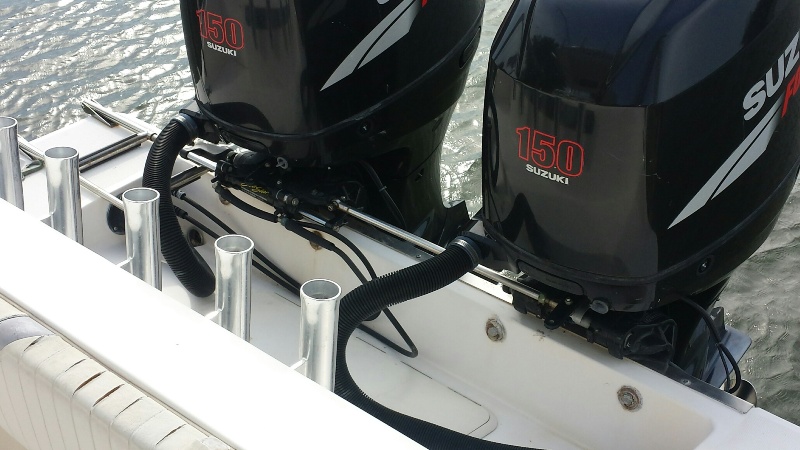
Hey Guys....that really sucks but glad everybody got home safe. I've read this entire post and I was wondering if one of you guys could tell me where on this picture I would attach a gaf to steer the motors after I have taped them together if I were to lose steering. I appreciate any suggestions.....
One of those center rod holders would make an ideal pivot point I was talking about. The picture is small but on your port engine I believe I see a 2nd hole in the steering arm forward of where the tie bar connects??? If so then that is where I said gaff it. If there is not a 2nd hole then disconnect the ram and gaff the hole where the bolt was and come in with just that motor. Tie the motor not being used straight or tilt out of the water.
So: gaff the steering arm, rope the gaff to one of your center rear rod holders, push the gaff handle to port to turn port, push it starboard to turn starboard.
With the pivot point it's the opposite of normal tiller steering.
If the steering is locked somewhere near straight, disconnect the port engine at the tie bar and gaff it as described. Use just the port to steer and come in with both engines.