

SWC Forums
Pull up a chair...let's talk fishing.

Barracuda should not be eaten because it may contain Ciguatera. Ciguatera toxin builds up in the flesh of reef predators which eat small reef fish which ingest smaller organisms which contain this toxin. Ciguatera causes cerebral edema (brain swelling) and can cause neurologic problems for an extended period of time in addition to severe headaches and reverse temperature sensation (cold things seem hot, hot things seem cold).
Larger barracudas are more likely to have more ciguatera toxin but smaller ones can definitely have it. Barracudas in the Carolinas can definitely have ciguatera toxin and there have been documented cases of ciguatera poisoning in North Carolina from eating barracuda. There is a case report in an old issue of the North Carolina Medical Journal.
Therefore it would be ill-advised to give away Barracuda to friends, acquaintances, or enemies no matter how good your intentions may be. It would be ill-advised for anyone to eat Barracuda caught in the Carolinas. Do all Barracuda have Ciguatera toxin? No! But the risk is too great to justify.

or enemies no matter
I'm good up to this point!

Read about ciguatera fish poisoning. Ciguatera is a toxin that is found in large reef fish such as the barracuda, red snapper, grouper and more. Symptoms ...
looks like the same toxins are possible in all fish we eat. why just single out baracuda?? i cant imagine just the baracuda can accumulate the toxin?
i certainly dont want to give away a fish that can be poisonous, but you think there would be some stronger warnings out there.
why is it more dangerous on the baracuda???
full article
Ciguatera Fish Poisoning (Toxin) Definition
Ciguatera is a foodborn illness (food poisoning) caused by eating fish that is contaminated by ciguatera toxin. Ciguatera toxin is a heat-stable lipid soluble compound, produced by dinoflagellates and concentrated in fish organs, that can cause nausea, pain, cardiac, and neurological symptoms in humans when ingested. The toxin may be found concentrated in large reef fish, most commonly barracuda, grouper, red snapper, eel, amberjack, sea bass, and Spanish mackerel. These fish live in coral reef waters and accumulate the toxin when they eat smaller reef fish which feed on the dinoflagellates. The area of concern include the Caribbean Sea, Hawaii, and coastal Central America. With fish from ciguatera endemic areas being shipped nationwide, poisonings can potentially occur in any areas in the United States.
Ciguatera toxin tends to accumulate in large predator fish (weight over 2 Kg or about 4.5 lbs), such as the barracuda and other carnivorous reef fish, because they eat other fish that consume toxin-producing algae (dinoflagellates), which live in coral reef waters. The toxin has highest concentrations in fish visceral and sex organs.
Ciguatera toxin is harmless to fish, but poisonous to humans. The toxin is odorless and tasteless, and cooking does not destroy the toxin. Eating ciguatera-contaminated tropical or subtropical fish is the main way that humans are exposed to the toxin. The toxin activates voltage-dependent sodium channels causing symptoms in human (and other mammals) gastrointestinal, cardiac, and nerve tissues. There are about 50,000 reported poisonings worldwide per year, but rarely cause death; children have more severe symptoms (see below).

I will be heading outa Southport with grsol84mm Saturday. I saw my boat giving me the stink eye today, gotta get her wet soon!
THey make good grouper bait too. My tuna tasted like cude.........
Was that a king in the second photo?
Ha ha
its cut twice measure once right????
my new platform...... the second time it actually big enough for cooler
she will be ready to roll on saturday... the plan is to follow BIG MOMMA!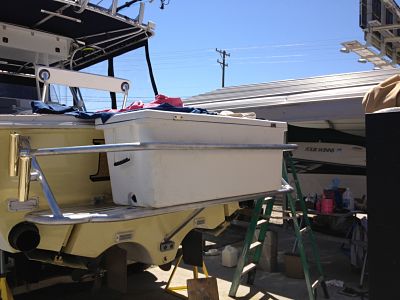
Nice touch with the rod holders! That's a big cooler Scott! That thing must be 7' long.
Big mamma gonna be on the fish Saturday. Gotta try to stay away from the crowd...

Platform looks good Scott.
The ciguatera discussion is interesting. I have always considered it a tropical/subtropical issue given that is where the various species algae thrive. I did a literature search and was only able to find one case report of 10 people getting ciguatera from eating fish caught in NC back in 1990 (they ate cuda, tuna, and mahi). All the other reports are from fish caught in warmer climates (mostly florida and carribean). One report had NC in the title but the fish eaten in NC was AJ caught in the FL keys. Interstingly, many of the reports outside the tropics were from Grouper and AJ caught in florida and bought at a market somewhere north. I think I'm safer eating a small cuda caught in NC than buying grouper at a market caught in FL. Just my $0.02
Scott, the platform looks great.
Chum, if in doubt we'll let Bambam try it first!
Roach, we better have John take a look and see if that is a king or a wahoo. On second thought maybe we better ask someone else! :lmao:

its cut twice measure once right????
my new platform...... the second time it actually big enough for cooler
she will be ready to roll on saturday... the plan is to follow BIG MOMMA!
That's a mighty expensive way to cover up the name of the boat. Why not just take it off :lmao:
All jokes aside. It looks good. Gives a few extra holders as well i see
Roach, we better have John take a look and see if that is a king or a wahoo. On second thought maybe we better ask someone else! :lmao:
damnit guys thats a wahoo! thats enough of that nonsense :lmao:
lets hope john doesnt see this.
chum i thinnk i read the same thing. the cases in nc were from amberjack not caught local. cuda has a bad rap for sure..... but ill probably still give it away vs eating it.
So I just got word that the boat is ready and I will be heading to pick it up Thursday. Well lets hope it's really ready this time. Anyways if it comes home we will be running Saturday as well. Most likely with the rest of this disgruntled bunch. Hope to see you all out there and catch em up. I know I will be