

SWC Forums
Pull up a chair...let's talk fishing.

There is no way that all of us will ever agree on most things but I do think that most of us agree that hatcheries will be a great idea. I honestly do not see how it could hurt in any way and lets push the few issues that we do agree upon. For dang sure the gov is not going to take the initiative
---- AND ---- while there are folks reading about things we can do to improve our fisheries here in NC, it needs to be noted that CCA is NOT against funding hatcheries. They support them wholeheartedly !
Google CCA+hatcheries. Do a little research and you will discover that CCA funded the startup and upgrading of numerous hatcheries all across the USA beginning 30 years ago in Texas. Tim knows. He has been there and seen what can be done.
CCA pushed for hatcheries all along the gulf coast in a recovery effort to the BP oil spill. Louisiana Grand Isle is a great model hatchery CCA helped establish. CCA help fund a salmon hatchery in Oregon that has been a tremendous success. There are other examples of states doing this, often initiated by CCA.
While I don't agree with all of CCA's positions, they do have the resource's best interests at heart.
Go to NCWATERMAN.COM and make a post about CCA supporting hatcheries in NC for species that MAY be caught or sold by a commercial fishermen, see what kind of input you get.
You can't search the forums over there anymore but there were post on there by the head of one of the CCA chapters, where he announced he was leaving CCA because they wouldn't support the flounder hatchery for this very reason. Tim might know something about this as well, as I think he is friends with the guy.
Several people have stated or hinted that a closure of inshore waters to shrimp trawling would put comm fishermen out of business. Really? What was the monetary value of shrimp harvested in NC by comm fishermen in waters other than the ocean/Pamlico Sound? What percentage of those shrimp caught in waters other than ocean/Pamlico Sound were caught by non-comm? Let's get some figures so we can separate the bull from the bulls**t.....
Fish Factory is right--what kind of sense is found in killing fingerling flounder, trout and croaker in order to harvest shrimp inside? Inside shrimper "Peter" is robbing comm /rec fisherman "Paul" in this case.
Plowhandle
We certainly do not want anyone to go out of business. The comms have a big investment in equipment and fuel costs are high. It is difficult to see how going 1 1/2 or 2 miles farther going out and back will have a huge financial drain. Sounds like $10 or $15 daily. If that or $40 or $50 will kill a business it will only do it a little early as it is not viable to begin with.
Quote Scalze.
Google CCA+hatcheries. Do a little research and you will discover that CCA funded the startup and upgrading of numerous hatcheries all across the USA beginning 30 years ago in Texas. Tim knows. He has been there and seen what can be done.
This is a correct statement. Sea Center Texas is a perfect example, and funded largely by CCA
I have a photo taken years ago, shaking hands with Dr. Robert Vega , Corpus Cristy, Tx. . This is one of three facilities operated by TPWD.
side bar: I was introduced to Dr. Vega by John Miller (NCSU)
Google Dr. Robert Vega TPWD ... want to talk "Stand-Up Guy"???
He gave me the "million dollar tour" of the entire facility, (Corpus Cristy) stem to stern...AND took the time to explain a lot of the different aspects of the operations/maintenance of the facility.
I realized right then and there, it was possible.
I was saying to myself, "If they can do it here, we can do it back home".
Come to find out, they (TPWD personnel) had all been trained at co-sponsored workshops held by Dr. Harry Daniels (NCSU) and Dr. Wade Watanabe (UNCW), here in NC.
This was many years ago, and that's when it really dawned on me that stock enhancement, and overall fisheries in general, are controlled by politics.
Politics for personal gain of those who could afford lobbyist, and those who controlled the house and senate.
I am blessed to have met the world leaders in southern flounder aquculture/stock enhancement right here in NC .
In this video, take a look at the next generation of fish farmers and/or stock enhancement specialist... if only they were given a chance :wall:
This video was taken this year in Bunn Level, NC
This building is over 500 ft. long, and is roughly 30% of the heated/cooled indoor square footage.
For anyone that does NOT believe we have the ability, RIGHT NOW, to do large scale stock enhancement AND/OR , grow cost effective fingerlings for commercial flounder farmers, (that wounld benefit our flounder fisheries), please raise you hand.
http://youtu.be/4qJrqPlHfEA

Silt suspension has very litlle to no effect on water oxygen content but does play a significant role in the temperature of water (clear v/s turbid). Microorganisms deplete oxygen of water not silt so no, no one else buys the argument.
Actually micro organisms apply oxygen they don't deplete it. What remains and falls to the bottom as decaying sediment is what depletes oxygen, aka hypoxia like this: http://sourcetosea.net/fish-kill-on-the-neuse-river/
"In summer water in surface layers in warmer than deeper water, resulting in lower oxygen solubility. Algae and plants in the surface layers work oppositely. They produce a high amount of oxygen at high temperatures, causing the water to become oxygen saturated. These plants die off pretty quickly, and are decomposed by micro organisms applying oxygen, which is now abundant in surface layers of the water source. However, organic matter often settles and remains on the bottom of a water body as sediment. This may cause oxygen deficits from decomposition."
Read more: http://www.lenntech.com/periodic/water/oxygen/oxygen-and-water.htm#ixzz2YbqGiZAJ
We certainly do not want anyone to go out of business. The comms have a big investment in equipment and fuel costs are high. It is difficult to see how going 1 1/2 or 2 miles farther going out and back will have a huge financial drain. Sounds like $10 or $15 daily. If that or $40 or $50 will kill a business it will only do it a little early as it is not viable to begin with.
LOL, $15 wouldn't complete two revolutions of the wheel on the Capt. Phillips.
Heck it takes $100+ just to get her to operating temperature.
----
While I don't agree with all of CCA's positions, they do have the resource's best interests at heart.
The only thing CCA has interest in is what goes in their and their members pocket.

Wow, this has devolved into what it always does. True colors come out quickly in a discussion like this. It only took one and a half pages of banter before all of the rec guys took up the CCA banner again. I think you guys know the difference is much bigger than a few more dollars in fuel to exit the inlet. The inside shrimpers are using much smaller rigs (in other words, using what they have). They are not capable of going outside in the ocean. I also know what the next statement will be which is "they aren't professional shrimpers then and need to go...."
It's the same thing as saying that the small home builder working off the back of his pickup needs to go if he cant afford a 40' trailer decked out with pneumatics. These are guys using what they have (very little in some instances) to make a living for the ones who depend on them. These are guys who do not sign up for handouts but rather get up before dawn every morning and make a go of it for their loved ones. When you successfully run them out of business, you guys are the very same type that will complain about the jobless a$$holes stripping your paycheck down to nothing.
I'm gonna catch hell for this but, it's not unlike the native americans being in the way of development way back when, it's a shame all these LOCAL, INDIGENOUS people are in the way of your hobby. Let's just move them out of the way, give them a few dollars for their losses, and before you know it, everything will be just the way we wanted it. Problem solved.
I wonder how the fish ever survived the old days when we really were shrimping. When Brunswick county had over a hundred trawlers alone dragging every single day???? I guess things really were just better then huh?
Silt suspension has very litlle to no effect on water oxygen content but does play a significant role in the temperature of water (clear v/s turbid). Microorganisms deplete oxygen of water not silt so no, no one else buys the argument.
Actually micro organisms apply oxygen they don't deplete it. What remains and falls to the bottom as decaying sediment is what depletes oxygen, aka hypoxia like this: http://sourcetosea.net/fish-kill-on-the-neuse-river/
"In summer water in surface layers in warmer than deeper water, resulting in lower oxygen solubility. Algae and plants in the surface layers work oppositely. They produce a high amount of oxygen at high temperatures, causing the water to become oxygen saturated. These plants die off pretty quickly, and are decomposed by micro organisms applying oxygen, which is now abundant in surface layers of the water source. However, organic matter often settles and remains on the bottom of a water body as sediment. This may cause oxygen deficits from decomposition."
Read more: http://www.lenntech.com/periodic/water/oxygen/oxygen-and-water.htm#ixzz2YbqGiZAJ
If you read your own references you see that I am correct. Nice try though. Your argument was silt suspension which has virtually nothing to do with % oxygen in the water. And like I said, microorganisms are responsible for oxygen deprivation.

Eric,
I think you are making a false equivalent. The small home builder does not rely on a public trust resource. The native Americans used every part of their catch and did not kill billions of fry in their fishing practices. One does not have a right to damage the fishery for everyone else just because a job is involved.
The MFC sure didn't care weather or not closing specks would hurt my business. However, me and most recs we're willing to take the hit if it was the best thing for the fishery.
Maybe many of the guys could switch to skimmer trawls, shrimp pounds or pots, cast nets or channel nets which have far less problems with by catch.
Silt suspension has very litlle to no effect on water oxygen content but does play a significant role in the temperature of water (clear v/s turbid). Microorganisms deplete oxygen of water not silt so no, no one else buys the argument.
Actually micro organisms apply oxygen they don't deplete it. What remains and falls to the bottom as decaying sediment is what depletes oxygen, aka hypoxia like this: http://sourcetosea.net/fish-kill-on-the-neuse-river/
"In summer water in surface layers in warmer than deeper water, resulting in lower oxygen solubility. Algae and plants in the surface layers work oppositely. They produce a high amount of oxygen at high temperatures, causing the water to become oxygen saturated. These plants die off pretty quickly, and are decomposed by micro organisms applying oxygen, which is now abundant in surface layers of the water source. However, organic matter often settles and remains on the bottom of a water body as sediment. This may cause oxygen deficits from decomposition."
Read more: http://www.lenntech.com/periodic/water/oxygen/oxygen-and-water.htm#ixzz2YbqGiZAJ
If you read your own references you see that I am correct. Nice try though. Your argument was silt suspension which has virtually nothing to do with % oxygen in the water. And like I said, microorganisms are responsible for oxygen deprivation.
Good grief guy, "organic matter often settles and remains on the bottom of a water body as sediment. This may cause oxygen deficits from decomposition."
But, not to worry or be concerned it's all a natural process and there is nothing wrong in the picture is there?
"Some bad news coming in from the Neuse River over the last few days. Larry Baldwin, the Riverkeeper for the lower Neuse River, and the NC Division of Water Quality are reporting at least 3.5 million fish have died in the Neuse since last Thursday due low oxygen levels. Menhaden, flounder, and even crabs have been washing up on shore.
A confluence of factors, including rain, heat, algae and an upwelling choked oxygen out of the river from Flanners Beach downstream to Slocum Creek, Susan Massengale, a spokeswoman for the N.C. Division of Water Quality, said Friday."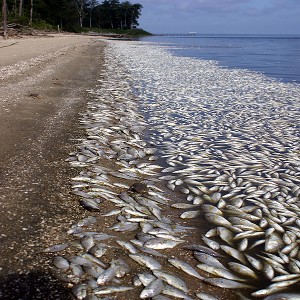
Silt suspension has very litlle to no effect on water oxygen content but does play a significant role in the temperature of water (clear v/s turbid). Microorganisms deplete oxygen of water not silt so no, no one else buys the argument.
Actually micro organisms apply oxygen they don't deplete it. What remains and falls to the bottom as decaying sediment is what depletes oxygen, aka hypoxia like this: http://sourcetosea.net/fish-kill-on-the-neuse-river/
"In summer water in surface layers in warmer than deeper water, resulting in lower oxygen solubility. Algae and plants in the surface layers work oppositely. They produce a high amount of oxygen at high temperatures, causing the water to become oxygen saturated. These plants die off pretty quickly, and are decomposed by micro organisms applying oxygen, which is now abundant in surface layers of the water source. However, organic matter often settles and remains on the bottom of a water body as sediment. This may cause oxygen deficits from decomposition."
Read more: http://www.lenntech.com/periodic/water/oxygen/oxygen-and-water.htm#ixzz2YbqGiZAJ
If you read your own references you see that I am correct. Nice try though. Your argument was silt suspension which has virtually nothing to do with % oxygen in the water. And like I said, microorganisms are responsible for oxygen deprivation.
Good grief guy, "organic matter often settles and remains on the bottom of a water body as sediment. This may cause oxygen deficits from decomposition."
But, not to worry or be concerned it's all a natural process and there is nothing wrong in the picture is there?
I'm confused. What does this have to do with otter trawls?
Some seem to think putting up hatcheries to produce more fry without addressing failing nursery areas will somehow solve a problem.