

SWC Forums
Pull up a chair...let's talk fishing.

I'very never done much offshore bottom fishing but i'm gonna try this year. How deep to start looking for these guys?

From CB/WB, go about 35-40 miles out & hope the sea bass haven't been devouring their new hatchlings!!! They usually bite better on squid than on cut bait & are sometimes suspended off the bottom.

Found this article when I was educating myself:
Beeliners can be located over live bottom, ledges, drop-offs, reefs, and artificial structure. They identify with that structure and will remain over it as long as there are baitfish available for them.
Considered bottom fish by many anglers, they aren’t truly bottom feeders. That’s the reason that so many anglers fishing for beeliners have a hard time catching a limit. These fish are not bottom feeders.
Bottom fishing in eighty to 150 feet of water over structure usually means dropping your bait to the bottom with a six or eight ounce sinker. After a couple of reels up off the bottom, you wait for a bite. Only an occasional beeliner will take a bait that close to the bottom, so you are relegated to grunts, pigfish, and seabass. Not that this is a bad thing, but if you are after beeliners, you are going to have a hard time.
Beeliners like to be higher in the water column. They feed midway in the water column, sometimes even coming to the surface. Like their close cousins, the yellowtail snapper, they school over a structure, not on the bottom around it.
Knowing how these fish behave helps us determine how to catch them. Essentially we need to put the bait where the fish are!
On a good depth finder a school of beeliners will show up over the structure, midway up in the water column. Catching them is easy if you either stop your bait half way to the bottom, or reel it half way back up after it gets to the bottom.
Occasionally a beeliner will hit a bait headed for the bottom as it goes by them, but the heavy sinkers more often send the bait past them far too fast for them to react.
One excellent method of catching beeliners is to use lighter tackle and a more natural presentation. Spinning tackle and ten pound test line will catch more beeliners than any other method if you use some special tactics.
Remember, the record for this fish is a little over seven pounds, so we aren’t talking about loosing a monster fish on light tackle.
Take a half or three-quarter ounce jig head and tie it to a two foot long fluorocarbon leader. That leader is joined to your line with a blood knot, not a swivel. Flashy swivels attract other, toothier fish, and cutoffs increase accordingly.
Use a chartreuse grub tail on the jig head, and a small piece of bait – either cut squid or small cut baitfish chunks. For some reason, beeliners seem to like the chartreuse color, and baits without the color generally catch fewer fish.
Allow the jig to freeline sink at its own rate. The bulkiness of the jig and bait combination slows the descent so that as it moves through the beeliner school, it will invariably be hit.
To use this method, you must be a line watcher. That is, you need to watch your loose line on top of the water as it slowly sinks. When a fish hits, the line will stop moving. At that point, reel up and set the hook. You don’t feel a bite; you simply see the line stop. Sometimes a particularly aggressive beeliner will hit hard enough that you can see the line being bumped. Again, that means set the hook!
You must be aware that an occasional barracuda, or amberjack will take your jig bait, and that can mean a long, exciting fight on light tackle – a bonus in most angler’s books!
Beeliners react aggressively and cooperatively to chum. You can actually chum them right to the surface behind the boat. At that point, simply casting a hook and small piece of bait to them will have your box filled with a limit in no time!
To work with chum, start by lowering your chum bag almost to the bottom. Every few minutes, bring it up ten feet or so, until you have it close to the surface at the stern of the boat. By now, the beeliners will have moved up with the chum slick, ready , willing and able to take any bait you put in front of them. This is a classic yellowtail method on the Florida Keys as well.
I read that same article. Thought the suspending part was interesting, and makes sense as they are snappers. I fish out of Ocean Isle.

ON SOME OF OUR BETTER BITE DAYS, WITH THE SUN HIGH, THEY WERE VISIBLY SUSPENDED RATHER HIGH IN THE COLUMN, ALL PODDED UP BENEATH THE HULL....SAY MAYBE 40 FEET DOWN....THEY APPEAR ALL WHITE AT THIS DEPTH....THIS IS WHERE THE MULTI CLORED LINES COME INTO PLAY FOR PRECISION DEPTH DROPS.
TO ANY NEWBIE TO BOTTOM FISHING: BE SURE YOU KNOW THE DIFFERENCE BETWEEN AN AMERICAN RED AND A BLINER. THEY AIN'T THE SAME.
I caught this HAWG B last month... early March...
I caught this guy up in the H20 column fishing for Triggs about 60 feet off the bottom on a beautifully butterflied piece of squid in about 140 feet of H20
Prolly close to a State Record! (Released!)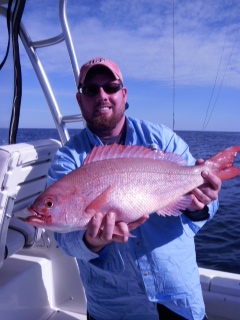
ON SOME OF OUR BETTER BITE DAYS, WITH THE SUN HIGH, THEY WERE VISIBLY SUSPENDED RATHER HIGH IN THE COLUMN, ALL PODDED UP BENEATH THE HULL....SAY MAYBE 40 FEET DOWN....THEY APPEAR ALL WHITE AT THIS DEPTH....THIS IS WHERE THE MULTI CLORED LINES COME INTO PLAY FOR PRECISION DEPTH DROPS.
TO ANY NEWBIE TO BOTTOM FISHING: BE SURE YOU KNOW THE DIFFERENCE BETWEEN AN AMERICAN RED AND A BLINER. THEY AIN'T THE SAME.
i can tell between genuines and beeliners. can also tell groupers. where i run into trouble is porgy's, silver snappers and the other ones that look alike.
MY BOSS INSISTS THAT I CALL OUT THE FISH SPECIES BY THE ACTUAL BITE ITSELF LONG BEFORE VISIBLITY..... THIS CONTEST OF HIS HAS BECOME QUITE THE THING ON HIS CONTENDER!
THE BEST SPECIES CALL TO DATE WAS BY BRIAN HIMSELF WHEN HE CALLED OCTOPUS THE MOMENT HE STARTED CRANKING....SURE ENOUGH,,,OL EIGHT LEGS WAS THERE.
THAT IS A NICE FISH DUDE! A MONEY FISH WITHOUT A DOUBT...I'M TOLD YOU CAN BRING IN A STATE RECORD ANYTIME 24/7/365....BUT IT MUST QUALIIFY AS ONE WITHOUT A DOUBT OR ELSE
Red porgy/silver snapper/pinky are the same fish & have to be over 14", 3 per person limit. White grunts are what we call gray snapper & is included in the "Reef Fish Complex". This is from the NC Dept of Marine Fisheries:
(H) Reef complex species: whitebone porgy, jolthead porgy, knobbed porgy, longspine porgy, sheepshead, gray triggerfish, queen triggerfish, yellow jack, crevalle jacks, bar jack, almaco jack, lesser amberjack, banded rudderfish, white grunt, margates, spadefish and scup. 20 per person per day in combination.
Hope that helps.
Something simple I stumbled upon a few years back was, using a "sabiki rod and rig" to find em'. For some reason they can't resist those little bait's. Just drop it down a few fathom's at a time and give it a bit of a sweep. If they are anywhere around, you'll find out. Mark the line swicth to heavier tackle and have at it. Sorry it isn't more "scientific" but it work's! Frank

I've found that the nicest B-liners are at the top of the school, stop baits above school with rod held high, engage reel, slowly let bait into school by lowering rod, and sort of anticipate the bite and put tension upwards, not really jerk but have the momentum upwards.
Silver shinny cut bait works too, squid is best, but boston mackeral isn't bad, just have to be quick setting the hook because the b-liners will clean it off the hook in less than a second.
several small pieces per hook is best particularly if triggers are mixed in.
Thanks for the help guys. Now i've just gotta find myself some spots!

I, myself, am trying tp master bottom fishing this year. This info is great!
Where are you guys fishing out of?
Usually mhc or nti