

SWC Forums
Pull up a chair...let's talk fishing.

Last week, the SAFMC approved the following no-fishing spawning Special Management Zones as the preferred alternatives in proposed Snapper-Grouper Amendment 36:
North Carolina: South Cape Lookout - 5 sq. miles
South Carolina: Devil's Hole/Georgetown Hole - 3.1 sq. miles
Georgia: No sites
Florida: Warsaw Hole - 1 sq. mile
While it's a significant accomplishment to have the total amount of proposed closed areas reduced from 70 sq. miles to about 9 sq. miles, there is still no justification for the action, which will unnecessarily hurt fishermen and fishing communities.
The SAFMC effectively deferred action on the snapper-grouper Vision Project until next month, when hopefully they will honor their promise of a "stakeholder-driven" plan and remove overwhelmingly opposed catch shares, closed fishing areas, and electronic vessel monitoring from the project.
Read more here: www.sustainablefishing.org/important_fishery_council_actions_last_week

Tom,
Do you have MAP that sows these areas?
If not....Get the lat and Lon and I will make you one.
Dave
A map that includes the SAFMC's preferred 5 sq. mile South Cape Lookout SMZ off NC is attached.
The corner coordinates are as follows:
76 28.617
33 53.04

76 27.798
33 52.019

76 30.627
33 49.946
76 31.424
33 51.041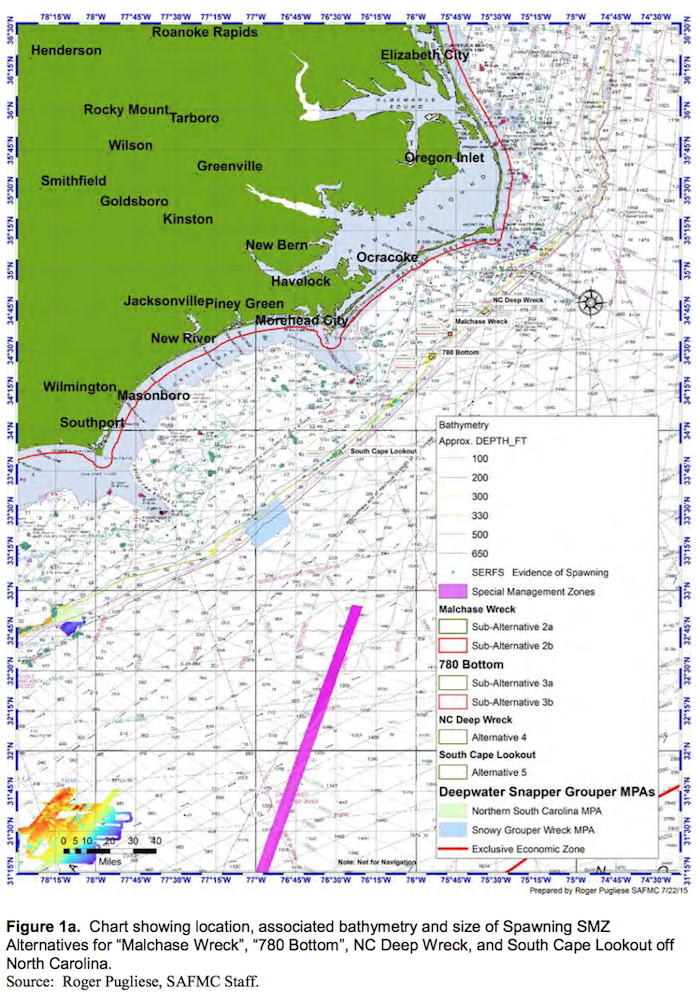
The council's justification for pushing these SMZs is that they told the judge during the Amendment 17B lawsuit they would take action to reduce the number of Warsaw Grouper and Speckled Hind being killed by fishermen. We could stop these new closures IF enough fishermen agreed to release those fish with descending devices when necessary. It would be very helpful if groups like the CFSF and RFA supported this simple solution.
Chris,
The NMFS won the lawsuit over it's repeal of the 240' closure through Reg. Amend. 11. The judge did not require any further action regarding speckled hind or warsaw grouper.
Here's a link to the ruling:
www.courtlistener.com/opinion/2742210/natural-resources-defense-council-v-national-marin/
We are on record with the SAFMC as supporting use of descending devices.
CFSF, council members tell me that the primary reason for rushing these SMZs is to reduce dead discards of Warsaw Grouper and Speckled Hind. Why wouldn't we want to offer an alternative solution that is proven to work rather than just saying no?
Chris, Do you know why the council members would be telling you that the new SMZ's are to prevent dead discards yet Amendment 36 says the justification is for "spawning" purposes?I realize that if no one is fishing there that there won't be any dead discards but if that's the reason for closing off an area,then publish that as the justification and then show me the proof that says these species aren't making a recovery under existing regulations/MPAs. From what I have read, there is no mention in the Amendment of prevention of dead discards.A good number of fishermen and groups have spoken up against more closed areas.The existing MPAs have not been evaluated or monitored yet and the plan the Council intends to use to evaluate/monitor the MPAs/SMZs is still in the works. The old "cart before the horse" deal.I have not read or heard of any fisherman/fishing group coming out against the use of descending devices in those deep water situations. The Council has been aware of these devices for some time now and have chosen pretty much to ignore them. These additional closed areas are not warranted BUT they are necessary to appease the NGO's such as EDF and others.If you'll remember several years back we were told by the Council's science staff that a huge area from off Florida to off N.C. had to be closed to bottom fishing or the Red Snapper had NO chance of recovering.The area was not closed due to great public opposition yet guess what? Red Snapper are back in a BIG way(yet to be acknowledged by the "powers that be").
A Gulf & South Atlantic Fisheries Development Foundation Observer Project "concluded the bycatch level of speckled hind/warsaw grouper was too low to generate an estimate of bycatch for the South Atlantic commercial snapper grouper fishery." So excessive bycatch does not appear to be an issue.
It's important to remember that Amend. 36 is not part of any required fishery rebuilding plan. It's purely an optional action on the part of the SAFMC.
We support the SAFMC approving ASAP a plan to monitor and evaluate the 700 sq. miles of existing deep-water MPAs that were enacted 6 years ago to protect spawning speckled hind and warsaw grouper.
And again, we support use of descending devices.
Protecting key spawning areas is the official reason given for Amendment 36. Protecting WG and SH with these closures is intended to appease the NGOs that sued NMFS and tried for ESA listings. That is why they looked for areas with a history of holding WG and SH. There appears to be a rush to close as much area as possible as quick as possible by any means necessary.
It is important for us to offer practical solutions rather than just saying no or asking the council to do things like collect better data and monitor closed areas. The council's idea of monitoring MPAs is VMS and onboard cameras to collect better data.
Most fishermen support a Stop and Review policy. We just need to coordinate our message and efforts. Would the CFSF be willing to write a statement supporting Stop and Review or whatever you want to call it and ask stakeholders to send a copy to the council and their members of Congress?
Monitoring in this case means resource monitoring in the MPAs, not monitoring fishermen.
According to the draft MPA evaluation plan, "the main objective is to determine and monitor the effect of MPAs on deepwater snapper grouper species’ distribution and status."
Here's a link to our August letter on Amend. 36:
https://d3n8a8pro7vhmx.cloudfront.net/sustainablefishing/pages/91/attachments/original/1443061388/CFSF-_Amend._36_comments__Aug._24__2015.pdf?1443061388
"Should the fishery council decide to move forward with the live bottom spawning SMZs despite the lack of justification, we ask the council to use the SMZ alternatives that are the smallest in size to reduce impacts on fishermen, reconsider how the transit provision works, and drop consideration of any live bottom SMZs off South Carolina, particularly the Georgetown Hole."
This is why we are slowly losing our freedom to fish. Defense only slows the advance of an anti-fishing agenda. Promoting positive solutions that benefit everyone and the resource is a path to enhancing our fisheries and advancing our fishing freedoms. I will continue doing my part and ask anyone who thinks we should do more than just say no or not in my back yard to join me. We have power in numbers. Feel free to email me if you would like to have a private discussion. Thank you. freefish7@hotmail.com

How do they plan on enforcing these SMZ's (assuming vessel monitoring requirements are not implemented)?? I'm not a fan of the NC SMZ site...
How do they plan on enforcing these SMZ's (assuming vessel monitoring requirements are not implemented)?? I'm not a fan of the NC SMZ site...
The council's response to enforcing SMZs without VMS was drones, satellites and Coast Guard patrols. They still want some kind of tracking device if they can sneak it in with something like electronic logbooks.
The solution I have promoted for monitoring existing MPAs is marking them with data buoys equipped with cameras above and below the surface. This would allow constant surveillance of marine life and poachers.
Tom, with all due respect. You said:
A Gulf & South Atlantic Fisheries Development Foundation Observer Project "concluded the bycatch level of speckled hind/warsaw grouper was too low to generate an estimate of bycatch for the South Atlantic commercial snapper grouper fishery." So excessive bycatch does not appear to be an issue.
1. If they cannot catch enough to generate an estimate of bycatch, one might conclude that there are not very many of them. Of course this is fisheries dependent data, which can have issues.
2. If they cannot catch enough to be a representative sample, then one cannot conclude whether there are too few or too many.
3. The Gulf and South Atlantic Fisheries Foundation is an industry association.
http://www.gulfsouthfoundation.org/about/
Thus, I do not see how you came to the conclusion you stated.
I'm reporting what the study concluded: commercial bycatch of speckled hind and warsaw grouper was low.