

SWC Forums
Pull up a chair...let's talk fishing.

Apologies if this has already been posted
FOR INFORMATION CONTACT: January 13, 2009
Kate Michie, or Kate.Michie@noaa.gov FB09-004
727/824-5305, FAX 727/824-5308
http://sero.nmfs.noaa.gov
NOAA Fisheries Service Publishes Final Rule to Establish Marine Protected Areas for Snapper-Grouper in U.S. Federal Waters of the South Atlantic
NOAA Fisheries Service published a final rule to implement Amendment 14 to the South Atlantic Snapper Grouper Fishery Management Plan (FMP) in the Federal Register on January 13, 2009 (74 FR 1621). The South Atlantic Fishery Management Council (Council) submitted Amendment 14 and associated Final Environmental Impact Statement for review, approval, and implementation by NOAA Fisheries Service.
The rule establishes eight Type 2 Marine Protected Areas (MPAs) in federal waters ranging from North Carolina to Florida (see Figure 1). A Type 2 MPA is an area within which fishing for or retention of snapper-grouper species is prohibited but other types of legal fishing, such as trolling, are allowed. The prohibition on possession does not apply to a person aboard a vessel that is in transit with fishing gear appropriately stowed.
Figure 1. Map of proposed Type 2 MPA’s.
The use of shark bottom longline gear is also prohibited within the MPAs. However, this provision; however, has been implemented through Amendment 2 to the Consolidated Highly Migratory Species (HMS) FMP
drafted by the HMS Division of NOAA, which is responsible for the management of HMS fisheries. The Amendment 2 final rule was published on June 24, 2008 (73 FR 35778).
The primary purpose of implementing these MPAs is to protect a portion of the population and habitat of long-lived, deep-water snapper-grouper species (speckled hind, snowy grouper, warsaw grouper, yellowedge grouper, misty grouper, golden tilefish, and blueline tilefish) from directed fishing pressure to achieve a more natural sex ratio, age, and size structure, while minimizing adverse social and economic effects.
Addresses
Electronic copies of Amendment 14 and the rule can be viewed on line at http://www.regulations.gov. Copies of the amendment and the rule may also be obtained from the Council by:
Sending a written request to:
NOAA Fisheries Service
Southeast Regional Office
Sustainable Fisheries Division
263 13th Avenue South
St. Petersburg, Florida 33701-5505
Or by e-mailing safmc@safmc.net, or calling the Council’s toll free number: 1-866-SAFMC-10, or sending a written request to:
South Atlantic Fishery Management Council
4055 Faber Place, Suite 201
North Charleston, South Carolina 29405
How Can We Improve These Fishery Bulletins?
If you have any suggestions on how we may improve the contents of future fishery bulletins please contact:
Kim Amendola, Communication Specialist
Phone: 727-551-5707, FAX: 727-824-5320
e-mail: SERO.Communications.Comments@noaa.gov.

[Federal Register: July 16, 2008 (Volume 73, Number 137)]
[Proposed Rules]
[Page 40824-40829]
From the Federal Register Online via GPO Access [wais.access.gpo.gov]
[DOCID:fr16jy08-34]
=======================================================================
-----------------------------------------------------------------------
DEPARTMENT OF COMMERCE
National Oceanic and Atmospheric Administration
50 CFR Part 622
[Docket No. 0612242911-7380-01]
RIN 0648-AU28
Fisheries of the Caribbean, Gulf of Mexico, and South Atlantic;
Snapper-Grouper Fishery off the Southern Atlantic States; Amendment 14
AGENCY: National Marine Fisheries Service (NMFS), National Oceanic and
Atmospheric Administration (NOAA), Commerce.
ACTION: Proposed rule; request for comments.
-----------------------------------------------------------------------
SUMMARY: NMFS issues this proposed rule to implement the applicable
provisions of Amendment 14 to the Fishery Management Plan for the
Snapper-Grouper Fishery of the South Atlantic Region (FMP), as prepared
and submitted by the South Atlantic Fishery Management Council
(Council). Amendment 14 proposes, and this rule would implement,
establishment of eight marine protected areas (MPAs) in which fishing
for or possession of South Atlantic snapper-grouper would be
prohibited. The prohibition on possession would not apply to a person
aboard a vessel that was in transit with fishing gear appropriately
stowed. Amendment 14 also proposes to prohibit the use of shark bottom
longlines within the MPAs, however, NMFS is proposing to implement the
prohibition of shark bottom longlines through separate rulemaking. The
intended effects of this proposed rule are to protect a portion of the
population and habitat of long-lived, slow growing, deepwater snapper-
grouper from fishing pressure to achieve a more natural sex ratio, age,
and size structure within the proposed MPAs, while minimizing adverse
social and economic effects.
DATES: Written comments on this proposed rule must be received no later
than 5 p.m., eastern time, on August 15, 2008.
ADDRESSES: You may submit comments, identified by ``0648-AU28'', by any
of the following methods:
Electronic Submissions: Submit all electronic public
comments via the Federal e-Rulemaking Portal http://
www.regulations.gov.
Fax: 727-824-5308; Attention: Kate Michie.
Mail: Kate Michie, Southeast Regional Office, NMFS, 263
13\th\ Avenue South, St. Petersburg, FL 33701.
Instructions: All comments received are a part of the public record
and will generally be posted to http://www.regulations.gov without
change. All Personal Identifying Information (for example, name,
address, etc.) voluntarily submitted by the commenter may be publicly
accessible. Do not submit Confidential Business Information or
otherwise sensitive or protected information.
NMFS will accept anonymous comments. Attachments to electronic
comments will be accepted in Microsoft Word, Excel, WordPerfect, or
Adobe PDF file formats only.
Copies of Amendment 14 may be obtained from the South Atlantic
Fishery Management Council, 4055 Faber Place, Suite 201, North
Charleston, SC 29405; phone: 843-571-4366 or 866-SAFMC-10 (toll free);
fax: 843-769-4520; e-mail: safmc@safmc.net. Amendment 14 includes a
Final Environmental Impact Statement (FEIS), a Biological Assessment,
an Initial Regulatory Flexibility Analysis (IRFA), a Regulatory Impact
Review, and a Social Impact Assessment/Fishery Impact Statement.
FOR FURTHER INFORMATION CONTACT: Kate Michie, telephone: 727-824-5305,
fax: 727-824-5308, e-mail: Kate.Michie@noaa.gov.
SUPPLEMENTARY INFORMATION: The snapper-grouper fishery off the southern
Atlantic states is managed under the FMP. The FMP was prepared by the
Council and is implemented under the authority of the Magnuson-Stevens
Fishery Conservation and Management Act (Magnuson-Stevens Act) by
regulations at 50 CFR part 622. NMFS issues this proposed rule to
implement the applicable provisions of Amendment 14 to the FMP. The
Atlantic shark fishery is managed under the Consolidated Highly
Migratory Species Fishery Management Plan (HMS FMP). The HMS FMP is
implemented under the authority of the Magnuson-Stevens Act by
regulations at 50 CFR part 635.
[[Page 40825]]
Background
Many snapper-grouper species are vulnerable to overfishing because
they are long-lived (e.g., snowy grouper, golden tilefish, red snapper,
gag, scamp, red grouper, and red porgy); they are protogynous, i.e.,
they may change sex from females to males as they grow older/larger
(e.g., snowy grouper, speckled hind, Warsaw grouper, yellowedge
grouper, gag, scamp, red porgy, and black sea bass); they form spawning
aggregations (e.g., snowy grouper, gag, scamp, and red snapper); and
they suffer high release mortality when taken from deep water.
Deepwater snapper-grouper species (speckled hind, snowy grouper, Warsaw
grouper, yellowedge grouper, misty grouper, golden tilefish, and
blueline tilefish) are most vulnerable to overfishing because they live
longer than 50 years, do not survive the trauma of capture, and are
protogynous (groupers) or exhibit sexual dimorphism, i.e., males and
females grow at different rates (tilefishes).
Stock assessments indicate that black sea bass, red porgy, and
snowy grouper are overfished, i.e., spawning stock biomass is not
sufficient to reproduce and support continued productivity. In
addition, black sea bass, golden tilefish, snowy grouper, and vermilion
snapper are experiencing overfishing, i.e., the current rate of fishing
mortality jeopardizes the capacity of the fishery to produce its
maximum sustainable yield on a continuing basis. Reductions in catch
and protection of habitat are needed.
Proposed Measures
This rule would establish eight MPAs in which a portion of the
population and habitat of long-lived, slow growing, deepwater snapper-
grouper species would be protected from directed fishing pressure.
Fishing for or possession of South Atlantic snapper-grouper would be
prohibited in the MPAs. However, the prohibition on possession would
not apply to a person aboard a vessel that was in transit with fishing
gear appropriately stowed, as specified in Sec. 622.35(i)(2) of this
proposed rule. MPAs are considered to be the most effective fishery
management tool that would allow deepwater snapper-grouper to reach a
more natural sex ratio, age, and size structure, protect spawning
locations, and provide a refuge for early developmental stages of fish
species.
Using a collaborative process, the Council selected specific sites
for MPAs on the basis of maximizing the biological benefits and
enhancing enforceability and monitoring while minimizing the adverse
social and economic effects. Sizes of the MPAs would range from
approximately 5 by 10 nautical miles (nm) to approximately 22 by 23 nm.
One would be off North Carolina, three off South Carolina, one off
Georgia, and three off the east coast of Florida. An artificial reef
may be established at one of the South Carolina sites. The two most
southern MPAs would be approximately 9 and 13 nm offshore,
respectively, and the others at least 38 nm offshore. The eight
proposed MPAs and their relative locations are shown in Figure 1.
The prohibition of use of shark bottom longlines in the MPAs is
considered necessary for habitat protection and to prevent the
mortality of incidentally caught snapper-grouper. The Council voted to
include this prohibition in Amendment 14 because of concerns regarding
the enforcement of fishing activities by vessels that hold permits in
both the snapper-grouper and shark bottom longline fisheries, both of
which deploy similar gear. However, because the Atlantic shark fishery
is managed under the HMS FMP, NMFS requested the HMS Division
promulgate the prohibition of use of shark bottom longlines within the
proposed MPAs. The HMS Division published a final rule on June 24, 2008
(72 FR 35778), prohibiting shark bottom longlining in the proposed MPAs
through Amendment 2 to the consolidated HMS FMP.
Availability of Amendment 14
Additional background and rationale for the measures discussed
above are contained in Amendment 14. The availability of Amendment 14
was announced in the Federal Register on June 6, 2008, (73 FR 32281).
Written comments on Amendment 14 will be accepted through August 5,
2008. All comments received on Amendment 14 or on this proposed rule
during their respective comment periods will be addressed in the
preamble to the final rule.
Classification
Pursuant to section 304(b)(1)(A) of the Magnuson-Stevens Act, the
NMFS Assistant Administrator has determined that this proposed rule is
consistent with Amendment 14, the Magnuson-Stevens Act, and other
applicable law, subject to further consideration after public comment.
This proposed rule has been determined to be not significant for
purposes of Executive Order 12866.
The Council prepared an FEIS for Amendment 14; a notice of
availability was published on June 13, 2008 (73 FR 33813).
NMFS prepared an IRFA, as required by section 603 of the Regulatory
Flexibility Act, for this proposed rule. The IRFA describes the
economic impact this proposed rule, if adopted, would have on small
entities. A description of the action, why it is being considered, and
the objectives of, and legal basis for this action are contained at the
beginning of this section in the preamble and in the SUMMARY section of
the preamble. A copy of the full analysis is available from the Council
(see ADDRESSES). A summary of the IRFA follows.
This proposed rule would establish eight MPAs in the Federal waters
of the South Atlantic and prohibit fishing for or possession of South
Atlantic snapper-grouper within any of the MPAs. The purpose of this
proposed rule is to assist in the recovery of overfished stocks and
persistence of healthy fish stocks, fisheries, and habitats. The
Magnuson-Stevens Act provides the statutory basis for the proposed
rule.
No duplicative, overlapping, or conflicting Federal rules have been
identified.
Two general classes of small business entities would be directly
affected by the proposed rule, commercial fishing vessels and for-hire
fishing vessels. The Small Business Administration defines a small
entity in the commercial fishing sector as a firm that is independently
owned and operated, is not dominant in its field of operation, and has
average annual gross receipts not in excess of $4 million (2002 NAICS
11411). For a for-hire business, the appropriate revenue benchmark is
$6.5 million (2002 NAICS 487210).
Average net incomes estimated from boats operating in the South
Atlantic snapper-grouper fishery were sampled in a 1994 study that
separated the fishery into northern and southern zones. The northern
zone includes the area north of 28[deg] N. latitude to the North
Carolina/Virginia border. The southern zone includes the area south of
25[deg] N. latitude to the border between the South Atlantic and Gulf
of Mexico Fishery Management Councils. The estimated average net
incomes, in 1994 (and 2006) dollars, were $83,224 ($113,212) for boats
that primarily used bottom longlines in the northern zone, $23,075
($31,389) for boats that primarily used black sea bass pots in the
northern zone, $15,563 ($21,171) for boats that primarily used bottom
longlines in the southern zone, $11,649 ($15,842) for boats that
primarily used vertical lines in the southern zone, and $8,307
($11,300) for boats that primarily used
[[Page 40826]]
vertical lines in the northern zone. Overall, boats in the northern
zone averaged $14,143 ($19,239) in net income based on average revenues
of $48,702 ($66,250), while boats in the southern zone averaged $12,388
($16,852) net income based on average revenues of $39,745 ($54,066).
More recent data from the Southeast logbook program show the average
annual ex-vessel revenue from landings of snapper-grouper species per
vessel from 1999 to 2003 to range from $14,408 to $16,376 (2006
dollars).
Although some fleet activity may exist in this fishery, the extent
of such has not been determined. Thus, all vessels are assumed to be
unique business entities. Given historic income data and the gross
revenue profile captured by the Southeast logbook program, it is
determined that all vessels that would be affected by the proposed rule
are small entities.
Charterboats are defined as boats for hire carrying six or fewer
passengers that charge a fee to rent the entire boat. Headboats tend to
be larger, generally can carry a maximum of around 60 passengers, and
the fee is paid on an individual angler basis. This analysis, which
estimates the range of the average gross revenues in 2006 dollars for
this sector, is as follows: $61,714 to $83,820 for charterboats on the
Atlantic coast of Florida; $72,768 to $88,778 for charterboats in North
Carolina, $31,830 to $38,833 for charterboats in South Carolina;
$68,629 to $83,486 for charterboats in Georgia; $170,276 to $362,482
for headboats in Florida; and $148,840 to $317,030 for headboats in the
other South Atlantic states. Similar to the situation with the
commercial harvest sector, some fleet activity may exist within the
for-hire sector. The magnitude and identity of such is unknown,
however, and all vessels are assumed to represent unique business
entities. Given the gross revenue profiles provided, vessels in the
for-hire recreational sector are determined to be small business
entities.
There were 1,066 commercial snapper-grouper permitted vessels in
the South Atlantic during 2004. A number of these permitted vessels
were not active in the snapper-grouper fishery. It is not possible to
estimate the total number of true latent permits (i.e., those permits
which are not expected to be fished in any given year and may exist
only for speculative purposes) since permits with no associated
landings could become active in a subsequent year. The number of
permitted vessels, however, is an upper bound on the universe of
vessels in this fishery. The assumed lower bound of the universe of
vessels is the number of active vessels in the latest year for which
data are available. This lower bound estimate is 906 vessels, which is
the number of vessels/permits with recorded landings of snapper-grouper
species in the South Atlantic in 2003. The upper bound is the 1,066
commercial snapper-grouper permitted vessels in the South Atlantic
during 2004. Thus, the range of vessels assumed to potentially operate
in the commercial snapper-grouper fishery is 906 to 1,066. Currently,
there is insufficient information to determine the number of commercial
fishing vessels that fish for or possess any snapper-grouper species in
the proposed MPAs.
In the for-hire sector, 1,594 snapper-grouper for-hire permits were
issued to vessels in the South Atlantic states in 2004. The for-hire
fishery operates as an open access fishery, and not all of the
permitted snapper-grouper for-hire vessels are necessarily active in
this fishery. Some vessel owners have been known to purchase open
access permits as insurance for uncertainties in the fisheries in which
they currently operate. Currently, there is insufficient information to
assess the number of for-hire vessels that fish for or possess any
snapper-grouper species in the proposed MPAs.
There is insufficient information to assess the numbers or
percentages of commercial and for-hire vessels that fish for or possess
snapper-grouper species in the proposed MPAs and would be directly
affected by the proposed rule. Consequently, it cannot be determined if
the proposed rule would affect a substantial number of small entities.
A direct cost of the proposed rule would be the lost revenues and
profits derived from fishing for or possessing snapper-grouper species
in those areas. It is expected that any vessel that historically fished
in these areas would mitigate some of these losses by relocating to
other areas. There is insufficient information to quantify any
potential losses of revenues and profits from the creation of the MPAs.
However, the relatively small sizes of the MPAs suggest there would not
be significant adverse economic impact.
Three alternatives, including the status quo, were considered for
the first of the eight actions. Both the proposed action (Alternative
1) and Alternative 2 would establish an MPA at the area of the Snowy
(Grouper) Wreck off the coast of North Carolina. The proposed MPA is 55
nm southeast of Southport, North Carolina, and Alternative 2 is located
approximately 57 nm southeast of Southport. Each MPA is about 15 by 10
nm. Fishermen from Little River, Carolina Beach, and Southport ports
would most likely be affected by either alternative. The proposed MPA
and the MPA specified by Alternative 2 include an area ranging from 150
meters (m) to 300 m deep. The proposed MPA includes a shallow area
ranging from 60 to 100 m, while the MPA specified by Alternative 2
includes a deeper area exceeding 300 m in depth. Alternative 2 could
result in the displacement of fewer fishermen than the proposed action,
but would not be expected to protect as many mid-shelf species as the
proposed action. The status quo alternative (Alternative 3) would not
create an MPA in the Snowy (Grouper) Wreck area off the coast of North
Carolina, would not increase the protection of mid-shelf and deepwater
snapper-grouper species, and would not, therefore, meet the Council's
objective.
Four alternatives, including the status quo, were considered for
the second action. The proposed action (Alternative 2) and two of the
other alternatives (Alternatives 1 and 3) would establish an MPA off
the northern South Carolina coast. The proposed MPA is located
approximately 54 nm from Murrells Inlet, while Alternative 1 is located
approximately 61 nm from Murrells Inlet, and the MPA specified by
Alternative 3 is about 65 nm from Murrells Inlet. The proposed MPA and
the MPAs specified by Alternatives 1 and 3 are 10 by 5 nm in size. Both
the proposed MPA and the MPA specified by Alternative 1 run east to
west, while the MPA specified by Alternative 3 runs parallel to shore.
Waters in the proposed MPA area range from 50 to 180 m deep. The MPAs
specified by Alternatives 1 and 3 share an area ranging in depth from
70 to 140 m, but the MPA specified by Alternative 1 includes more
shallow waters, while the MPA specified by Alternative 3 includes a
greater area of deep water. The proposed MPA is expected to protect
more deepwater and mid-shelf snapper-grouper species than the MPAs
specified by Alternatives 1 and 3. The status quo alternative
(Alternative 4) would not create an MPA off the coast of northern South
Carolina, would not increase the protection of mid-shelf and deepwater
snapper-grouper species, and would not, therefore, meet the Council's
objective.
Three alternatives, including the status quo, were considered for
the third action. Both the proposed action (Alternative 1) and
Alternative 2 would establish an MPA off the coast of central South
Carolina. The proposed MPA is oriented perpendicular to the coast and
is located about 45 nm southeast of
[[Page 40827]]
Charleston Harbor. The MPA specified by Alternative 2 is oriented
parallel to the shoreline and is located approximately 50 nm southeast
of Charleston Harbor. Both MPAs are 10 by 5 nm in size. The proposed
MPA is expected to protect more mid-shelf and rare deepwater snapper-
grouper species than Alternative 2. The status quo alternative
(Alternative 3) would not create an MPA off the coast of central South
Carolina, would not increase the protection of mid-shelf and deepwater
snapper-grouper species, and would not, therefore, meet the Council's
objective.
Three alternatives, including the status quo, were considered for
the fourth action. Both the proposed action (Alternative 1) and
Alternative 2 would establish an MPA off the coast of Georgia. The
proposed MPA is located approximately 69 nm southeast of the mouth of
Wassaw Sound, while the MPA specified by Alternative 2 is located about
65 nm southeast of the mouth of Wassaw Sound. Both the proposed MPA and
the MPA specified by Alternative 2 are 10 by 10 nm in size, and both
share a common area with waters 90 to 210 m deep. However, the proposed
MPA also includes waters ranging from 90 to 300 m deep and runs
parallel to the shore, while the MPA specified by Alternative 2
includes an area with a wider depth range, from 65 to 380 m and does
not run parallel to the coast. The proposed MPA is expected to be
easier for industry to maneuver around and may result in greater
protection of the mid-shelf habitat that serves as a nursery for
deepwater species, notably tilefish, than the MPA specified by
Alternative 2. The status quo alternative (Alternative 3) would not
create an MPA off the coast of Georgia, would not increase the
protection of tilefish, snowy grouper, and mid-shelf snapper-grouper
species, and would not, therefore, meet the Council's objective.
Seven alternatives, including the status quo, were considered for
the fifth action. The proposed action (Alternative 4) and five of the
other alternatives would establish an MPA off the coast of north
Florida. The proposed MPA is approximately 60 nm off the mouth of St.
John's River near Jacksonville. The MPA specified by Alternative 1 is
approximately 57 nm off the mouth of the St. John's River; the MPA
specified by Alternative 2 is about 47 nm east of St. Augustine; the
MPA specified by Alternative 3 is approximately 43 nm off New Smyrna
Beach; the MPA specified by Alternative 5 is about 55 nm east of St.
Augustine; and the MPA specified by Alternative 6 is approximately 45
nm off New Smyrna Beach. The proposed MPA and the MPAs specified by
Alternatives 1, 2, and 5 are 10 by 10 nm in size, while the MPAs
specified by Alternatives 3 and 6 are 22 by 23 nm in size. The proposed
MPA shares an area with the MPA specified by Alternative 1 that ranges
from 60 to 200 m in depth. The proposed MPA also includes deeper
waters, ranging from 200 to 380 m in depth, while the MPA specified by
Alternative 1 includes an area of shallower water, ranging from 50 to
80 m in depth. The MPAs specified by Alternatives 2 and 5 share an area
with depths ranging from 90 to 150 m. The MPA specified by Alternative
5 also includes a deeper area that ranges from 150 to 390 m, while the
MPA specified by Alternative 2 includes a shallower area of 55 to 80 m.
Most of the area included by the MPAs specified by Alternatives 3 and 6
overlap in an area ranging from 200 to 690 m deep. The MPA specified by
Alternative 3 also includes a deeper area that exceeds 700 m, while the
MPA specified by Alternative 6 includes a shallower area of 80 to 150
m. Although the MPAs specified by Alternatives 1 and 2 would protect
more mid-shelf snapper-grouper species than the proposed MPA, while the
MPAs specified by Alternatives 3, 5 and 6 would protect more deepwater
species, these alternatives would also be expected to result in greater
adverse economic impacts than the proposed MPA. The status quo
alternative (Alternative 7), would not create an MPA off the coast of
north Florida, would not increase the protection of mid-shelf and
deepwater snapper-grouper species, and would not, therefore, meet the
Council's objective.
Two alternatives, including the status quo, were considered for the
sixth action. The proposed action would establish an MPA in the area
known as Sea Bass Rocks off the coast of Florida. The status quo
alternative would not create an MPA in this area, would not increase
the protection of deepwater snapper-grouper species in this area, and
would not, therefore, meet the Council's objective.
Two alternatives, including the status quo, were considered for the
seventh action. The proposed action would establish an MPA in the
vicinity of the area known as East Hump and Unnamed Hump off the coast
of the Florida Keys. The status quo alternative, would not create an
MPA in this area, would not increase the protection of deepwater
snapper-grouper and protected species in this area, and would not,
therefore, meet the Council's objectives.
Two alternatives, including the status quo, were considered for the
eighth action. The proposed action would establish an artificial reef
MPA off the coast of South Carolina. The status quo alternative would
not create this MPA, would not increase the opportunity to improve
snapper-grouper populations in this area, and would not, therefore,
meet the Council's objective.
List of Subjects in 50 CFR Part 622
Fisheries, Fishing, Puerto Rico, Reporting and recordkeeping
requirements, Virgin Islands.
Dated: July 10, 2008.
Samuel D. Rauch III,
Deputy Assistant Administrator For Regulatory Programs, National Marine
Fisheries Service.
For the reasons set out in the preamble, 50 CFR part 622 is
proposed to be amended as follows:
PART 622--FISHERIES OF THE CARIBBEAN, GULF, AND SOUTH ATLANTIC
1. The authority citation for part 622 continues to read as
follows:
Authority: 16 U.S.C. 1801 et seq.
2. In Sec. 622.2, the definition of ``MPA'' is added in
alphabetical order to read as follows:
Sec. 622.2 Definitions and acronyms.
* * * * *
MPA means marine protected area.
* * * * *
3. In Sec. 622.35, paragraph (i) is added to read as follows:
Sec. 622.35 Atlantic EEZ seasonal and/or area closures.
* * * * *
(i) MPAs. (1) No person may fish for a South Atlantic snapper-
grouper in an MPA, and no person may possess a South Atlantic snapper-
grouper in an MPA. However, the prohibition on possession does not
apply to a person aboard a vessel that is in transit with fishing gear
appropriately stowed as specified in paragraph (i)(2) of this section.
In addition to these restrictions, see Sec. 635.21(d)(1)(iii) of this
chapter regarding restrictions applicable within these MPAs for any
vessel issued a permit under part 635 of this chapter that has longline
gear on board. MPAs consist of deepwater areas as follows:
(i) Snowy Grouper Wreck MPA is bounded by rhumb lines connecting,
in order, the following points:
------------------------------------------------------------------------
Point North lat. West long.
------------------------------------------------------------------------
A 33[deg]25' 77[deg]04.75'
B 33[deg]34.75' 76[deg]51.3'
C 33[deg]25.5' 76[deg]46.5'
D 33[deg]15.75' 77[deg]00.0'
A 33[deg]25' 77[deg]04.75'
------------------------------------------------------------------------
[[Page 40828]]
(ii) Northern South Carolina MPA is bounded on the north by
32[deg]53.5' N. lat.; on the south by 32[deg]48.5' N. lat.; on the east
by 78[deg]04.75' W. long.; and on the west by 78[deg]16.75' W. long.
(iii) Edisto MPA is bounded on the north by 32[deg]24' N. lat.; on
the south by 32[deg]18.5' N. lat.; on the east by 78[deg]54.0' W.
long.; and on the west by 79[deg]06.0' W. long.
(iv) Charleston Deep Artificial Reef MPA is bounded by rhumb lines
connecting, in order, the following points:
------------------------------------------------------------------------
Point North lat. West long.
------------------------------------------------------------------------
A 32[deg]04' 79[deg]12'
B 32[deg]08.5' 79[deg]07.5'
C 32[deg]06' 79[deg]05'
D 32[deg]01.5' 79[deg]09.3'
A 32[deg]04' 79[deg]12'
------------------------------------------------------------------------
(v) Georgia MPA is bounded by rhumb lines connecting, in order, the
following points:
------------------------------------------------------------------------
Point North lat. West long.
------------------------------------------------------------------------
A 31[deg]43' 79[deg]31'
B 31[deg]43' 79[deg]21'
C 31[deg]34' 79[deg]29'
D 31[deg]34' 79[deg]39'
A 31[deg]43' 79[deg]31'
------------------------------------------------------------------------
(vi) North Florida MPA is bounded on the north by 30[deg]29' N.
lat.; on the south by 30[deg]19' N. lat.; on the east by 80[deg]02' W.
long.; and on the west by 80[deg]14' W. long.
(vii) St. Lucie Hump MPA is bounded on the north by 27[deg]08' N.
lat.; on the south by 27[deg]04' N. lat.; on the east by 79[deg]58' W.
long.; and on the west by 80[deg]00' W. long.
(viii) East Hump MPA is bounded by rhumb lines connecting, in
order, the following points:
------------------------------------------------------------------------
Point North lat. West long.
------------------------------------------------------------------------
A 24[deg]36.5' 80[deg]45.5'
B 24[deg]32' 80[deg]36'
C 24[deg]27.5' 80[deg]38.5'
D 24[deg]32.5' 80[deg]48'
A 24[deg]36.5' 80[deg]45.5'
------------------------------------------------------------------------
(2) For the purpose of paragraph (i)(1) of this section, transit
means direct, non-stop progression through the MPA. Fishing gear
appropriately stowed means--
(i) A longline may be left on the drum if all gangions and hooks
are disconnected and stowed below deck. Hooks cannot be baited. All
buoys must be disconnected from the gear; however, buoys may remain on
deck.
(ii) A trawl or try net may remain on deck, but trawl doors must be
disconnected from such net and must be secured.
(iii) A gillnet, stab net, or trammel net must be left on the drum.
Any additional such nets not attached to the drum must be stowed below
deck.
(iv) Terminal gear (i.e., hook, leader, sinker, flasher, or bait)
used with an automatic reel, bandit gear, buoy gear, handline, or rod
and reel must be disconnected and stowed separately from such fishing
gear. A rod and reel must be removed from the rod holder and stowed
securely on or below deck.
(v) A crustacean trap, golden crab trap, or sea bass pot cannot be
baited. All buoys must be disconnected from the gear; however, buoys
may remain on deck.
4. Add Figure 1 to Part 622 to read as follows:
[[Page 40829]]
[GRAPHIC] [TIFF OMITTED] TP16JY08.009
[FR Doc. E8-16252 Filed 7-15-08; 8:45 am]
BILLING CODE 3510-22-S
Map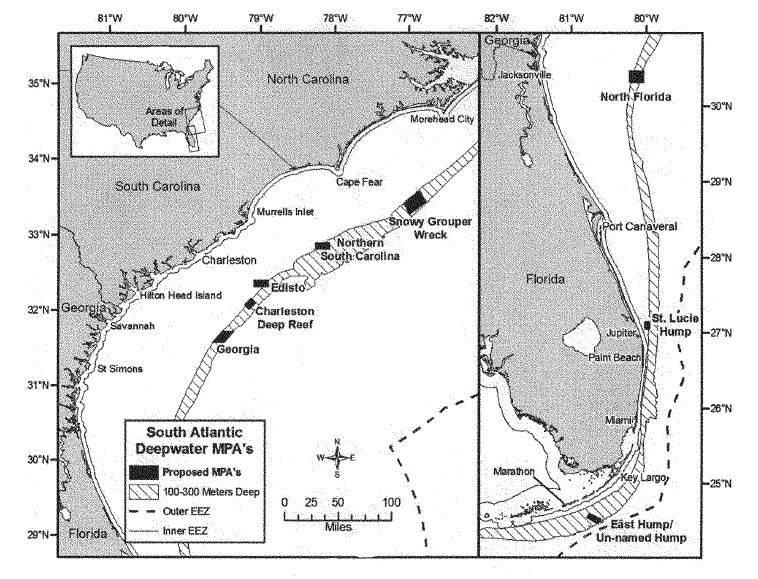

Look like good places for MPAs, right? Over 100 meters deep and in places known to be aggregation sites for grouper/snapper. Shouldn't impact the local fisheries unreasonably...

I'd rather not see mpa's
Here's why:
Now that we have MPA's how are we going to monitor them?
Every boat that fishes will have to buy a device that tells
them where you are at.
I personally don't trust them enough to let them know where my fishing spots are at.
Monitoring MPAs does seem like a pretty big obstacle, but so does enforcing bag limits, etc. when you think about it. If they patrol those areas occassionally it will deter people from fishing in these areas. I wasn't checked by Wildlife officers last year, but I did not keep over my bag limit.
One thing I noticed, is that the current map seems to show the proposed MPA, which for the Snowy Grouper wreck, includes shallow water to deep water (60-300 m). The alternatives 1 and 2 seek out smaller areas and may impact fishermen less and still protect the snapper/grouper. This seems to be the MPA most likely to affect the users of this site, so I thought it was interesting that it appeared to be the largest and have several options.

The only way they will be able to monitor these MPA'S effectively is to have all commercial/For-Hire vessels participating in the Snapper/ Grouper fishery to install a VMS system onboard there vessels. This system is nothing new and very effective. There not monitoring every boats every move or keeping track of your fishing spots it just alerts them when someone with a VMS enters the closed area and belive me they know your exact position, I know from experence. If the system is implimented and you don't install it you will not be able to fish.

Every time this debate comes up, the same guys are always against it, against everything suggested. Let me be blunt, it cant stay the way it is. So in the interest of providing your expert opinions, what do you suggest they do? Nothing? Leave it wide open to go and fish whenever and wherever we want at anytime?? Is that the answer? Well guess what, it's not going to happen. Please share what your thoughts are, we never hear anything positive, only how this or that wont work. I am tired of it to be honest. I hope they shut it down 1/1-4/30 each and every year..there ya go, I said it. Let the rain poor down on me, trust me I can take whatever you throw at me, at least I can think outside the box and think beyond the tip of my nose. I agree, there needs to be accurate data. I agree there is not a shortage TODAY, but what about in 10 years? Are we all that brilliant to declare there wont be a problem in the future?
Wide open was 15+ years ago, when they trapped groupers, long lined them and the grouper fleet was over double the size it is now.
Most of my good friends & good grouper fishermen have quit because
of the continuing pressure from groups of environmentalists that don't
Know what shape our fisheries are in and keep making stupid rules
Based on real shotty outdated science. I'm all about sustained fisheries.
But we reached that point Long ago. How would you like someone to tell
you that all the small groupers you have been throwing back for the last 15 years isn't doing any good, That just because half the fleet is gone and not fishing any more, thats not enough? The numbers speak for themselves, Divers & fishermen alike are seeing major increases
in groupers throughout our area. I'm sorry you're tired of hearing the truth about our fisheries, they are in pretty good shape. Whether you believe
it or not, Its True.

Every time this debate comes up, the same guys are always against it, against everything suggested. Let me be blunt, it cant stay the way it is. So in the interest of providing your expert opinions, what do you suggest they do? Nothing? Leave it wide open to go and fish whenever and wherever we want at anytime?? Is that the answer? Well guess what, it's not going to happen. Please share what your thoughts are, we never hear anything positive, only how this or that wont work. I am tired of it to be honest. I hope they shut it down 1/1-4/30 each and every year..there ya go, I said it. Let the rain poor down on me, trust me I can take whatever you throw at me, at least I can think outside the box and think beyond the tip of my nose. I agree, there needs to be accurate data. I agree there is not a shortage TODAY, but what about in 10 years? Are we all that brilliant to declare there wont be a problem in the future?
Preach It brother!!! :tu:
As I clearly stated in my post, I do not think there is a shortage TODAY
The fishing has been excellent, no doubt. But controls need to be in place. From what I gather Grouper/Snapper has not yet been evaluated properly to have legit data in order construct a viable plan, if one is needed at all.
I'm not heated about the MPA, I don't ever go near it and
don't ever plan to. I'm heated about having to put a transponder
on my boat, at my cost and if it malfunctions they can fine me or take away my permits. I'm not going near the MPA and never will.
I'm also sure there will be another MPA in the near future.
The researchers have caught Gag groupers in our MPA and are not
giving us credit for them being there. Its a done deal.
I wish they would take this opportunity to do some real research
by checking the bottom with divers or an ROV and check on its
status & progress, I want to hear some live head counts.
Some before & after pictures would be nice.
I want results.
As I clearly stated in my post, I do not think there is a shortage TODAY
The fishing has been excellent, no doubt. But controls need to be in place. From what I gather Grouper/Snapper has not yet been evaluated properly to have legit data in order construct a viable plan, if one is needed at all.
Controls are allready in place, Have been for years, there was a shortage
when the grouper fishing pressure reached its peak over a decade ago.
Since 1991 Grouper permits have not been issued
The 2 for 1 program sucked up alot of them
There are a little over 1000 Southeast grouper snapper permits around
Alot are inactive.
Gag groupers have undergone 2 size limit increases since then.
Reds & scamps have had one size limit increase.
There is the march & april gag grouper closed to commercial fishing
reg in place.
No more longlining groupers in the southeast.
No more trapping groupers in the southeast.
I'm sure a little refining of these rules would help.
Everyone has a right to there opinion, I'm just passing on the information
I know something about. Peace
I have to go with Joe on this one. Not becasue I we are friends....but becasue he is right. Grouper fishing has gotten better in the time I have been seriously fishing.
I do not see a problem with the Grouper Fishery now or in the future. If I did I would be the first to speak up about it.
You want ideas....Here is a couple for you....
Stop Gill Netting...Inside and outside...
Stop Inshore trawling...(There is one that me and Joe disagree on just so you don't think I am puppy dogging him or anything)
Stop Black Sea bass Traps...
So they say there is a problem with the Gag groupers....So they close ALL Shallow water Grouper fishing. This just shows how out of touch they (and you) are with Grouper Fishing. Look through the Continental Shelf Photos. How many Gags do you see me with? Not many...and the ones you do see me with were ALL caught inshore. I very seldome EVER catch Gags offshore. Why? Cause I am too deep. Yet they leave Black sea bass fishing and trapping open. Guess what? When ypou Blacksea bass fish in the winter....You tend to catch Gags. Those Traps they use to catch BSB....They Kill 10-1 more Gags than I have ever even seen. (I had a mate that ran 1 trip Seabass trapping and he would NEVER go again becasue of the bycatch)
I don't really have an issue with the MPA's as suggested and you have not really heard much from me about it....but this Closure BS is just that BS done by a bunch of know it all's that THINK they know something....but they don't know SHIT!
There I said it.
Dave
PS....
I have one more....
Stop buiding all this crap along the coast especiality GOLF COARSES!!! (Hell just look at the Clor Images in Supermap) and killing the gag nursury. What you say? They live in the ocean.....In the fall....take a live minnow....go find a grass bed and throw that little guy right along the edge of the grass.....Guess what youa re going to catch. Baby Gags.
From what I gather Grouper/Snapper has not yet been evaluated properly to have legit data in order construct a viable plan, if one is needed at all.
That is right.....I spend over 100 days a year Fishing offshore right here in NC....
Joe spends I bet over 150 days a year.
My guess is we have a little better handle on what is happening right here than most.
Dave