

SWC Forums
Pull up a chair...let's talk fishing.

NOAA proposes to designate critical habitat for loggerhead sea turtles in NW Atlantic and Gulf
In accordance with the statutory requirements of the Endangered Species Act, NOAA Fisheries today released for public comment a draft proposal to designate critical habitat for threatened loggerhead sea turtles (Caretta caretta) in the northwestern Atlantic Ocean and Gulf of Mexico. Critical habitat designations identify the habitat that is essential to endangered and threatened species.
Once finalized, critical habitat designation would not necessarily result in any restrictions on human activities. Only if an activity required federal actions, funding or permitting would the agency in question need to work with NOAA to avoid, reduce or mitigate potential impacts to the species or its habitat.
Members of the public can now submit comments on the agency’s draft proposal to aid in the recovery of this species. Last year, the President directed that any potential future designations of critical habitat carefully consider all public comments on relevant science and economic impact, including those that suggest methods for minimizing regulatory burdens. Any critical habitat designation will include a full analysis of economic impact, including impact on jobs, and will strive, to the extent permitted by law, to avoid unnecessary burdens and costs on states, tribes, localities, and the private sector.
“Loggerhead sea turtles are vulnerable to a variety of hazards that could threaten them,” said Sam Rauch, acting NOAA assistant administrator for fisheries. “When developing this proposal, NOAA Fisheries carefully examined a number of factors, including the unique biology and life history needs of the species as well as economic impacts. With assistance from the public, we can identify the right habitat these animals need to survive for decades to come.”
In 2007, NOAA and the U.S. Fish and Wildlife Service received legal petitions from the Center for Biological Diversity, the Turtle Island Restoration Network and Oceana, requesting that loggerhead turtles in the North Pacific and the Northwest Atlantic be reclassified as endangered distinct population segments, and that critical habitat be designated. These petitions prompted a formal review of the status of the turtles under the requirements of the Endangered Species Act.
Following detailed reviews by scientific experts, in 2011, NOAA Fisheries changed the listing of loggerhead sea turtles under the Endangered Species Act from a single threatened species to nine distinct population segments Two of these segments occur in United States’ waters, in the northwest Atlantic Ocean, where the turtles are threatened, and the north Pacific Ocean, where they are endangered.
The critical habitat proposed today for designation includes some nearshore reproductive habitat (areas directly off of nesting/hatching beaches from North Carolina through Mississippi), winter habitat (North Carolina), breeding habitat (Florida), and constricted migratory corridors (North Carolina and Florida).
No critical habitat is proposed for designation within the north Pacific Ocean segment. Areas under U.S. jurisdiction around Hawaii and along the U.S. west coast represent a very small percentage of suitable loggerhead habitat and do not meet the definition of critical habitat.
Written comments on the proposed regulations filed today must be sent to NOAA Fisheries no later than September 16, 2013.
NOAA’s Fisheries Service will consider public comments and any new information submitted during this period as it develops a final rule.
The public may submit comments via the Federal eRulemaking Portal at: www.regulations.gov<http> or by visiting the comment page on the Office of Protected Resources website at: www.nmfs.noaa.gov/pr/comment.htm<http>.
NOAA’s Fisheries Service will also accept written comments mailed to: Office of Protected Resources, NOAA Fisheries, 1315 East-West Highway, Silver Spring, MD 20910; or faxed to: 301-713-4060.
Background
Loggerhead sea turtles were listed as threatened throughout their range in 1978. In 2008, a biological review team of scientists identified nine biologically discrete and significant DPSs. In 2011, NOAA Fisheries issued a final rule changing the listing of loggerhead sea turtles under the Endangered Species Act from a single threatened species to nine distinct population segments.
Under the ESA, an “endangered” species is “in danger of extinction throughout all or a significant portion of its range.” A ‘threatened” species is “likely to become an endangered species within the foreseeable future throughout all or a significant portion of its range.”
Do you like driving on the beach?
You can KISS that goodbye if this goes through...
Dave

The critical habitat proposed today for designation includes some nearshore reproductive habitat (areas directly off of nesting/hatching beaches from North Carolina through Mississippi), winter habitat (North Carolina), breeding habitat (Florida), and constricted migratory corridors (North Carolina and Florida).
Near shore nets and trawls anyone?
Has anyone submitted comments we can copy and paste or use as a guide for our own?
I just got it when I posted it.
Dave
They have accumulated so much BS over the years who believes much or anything they have to say any more?
The critical habitat proposed today for designation includes some nearshore reproductive habitat (areas directly off of nesting/hatching beaches from North Carolina through Mississippi), winter habitat (North Carolina), breeding habitat (Florida), and constricted migratory corridors (North Carolina and Florida).
Near shore nets and trawls anyone?
Now you're starting to sound like a broken record. Gave you enough respect to think that maybe, just maybe you were a man of your own thoughts. Turtle excluder devices come to mind, in this case. Of course like nearly every other species, "we" are required to "save". They are just "managed" for use by those South or East of our borders. Turtles (regardless of species) are enjoyed by many of our Southern neighbors. Carry you cause there and see if they appreciate your efforts of a few more pounds gained before their capture. Really my respect for many of the respondants is dwindling pretty quickly. I know there is data some where of poundage caught by trawlers or purely commercial guy's out there somewhere. Did I mention, that without fail the turtles I have seen floating offshore have broken shells from what looks very simular to prop rake. Maybe it' the "go-fast" commercial boats, targeting said turtles. Dang shame how the inter-net makes some of us alotl smarter. Frank

NOAA and Endangered Species protection
Terms that when used together mean massive restrictions are coming to both sectors
The critical habitat proposed today for designation includes some nearshore reproductive habitat (areas directly off of nesting/hatching beaches from North Carolina through Mississippi), winter habitat (North Carolina), breeding habitat (Florida), and constricted migratory corridors (North Carolina and Florida).
Near shore nets and trawls anyone?
Now you're starting to sound like a broken record. Gave you enough respect to think that maybe, just maybe you were a man of your own thoughts. Turtle excluder devices come to mind, in this case. Of course like nearly every other species, "we" are required to "save". They are just "managed" for use by those South or East of our borders. Turtles (regardless of species) are enjoyed by many of our Southern neighbors. Carry you cause there and see if they appreciate your efforts of a few more pounds gained before their capture. Really my respect for many of the respondants is dwindling pretty quickly. I know there is data some where of poundage caught by trawlers or purely commercial guy's out there somewhere. Did I mention, that without fail the turtles I have seen floating offshore have broken shells from what looks very simular to prop rake. Maybe it' the "go-fast" commercial boats, targeting said turtles. Dang shame how the inter-net makes some of us alotl smarter. Frank
Frank, just pointing out the obvious. I even put it in bold for you. I have said for years that all the turtle advocates really had to do was sue under the ESA to get nets and trawls out. Think about it, if a person can't rescue a friggin' turtle under ESA, then how does anyone think ESA will allow especially nets to impede, capture, and potentially harm turtles. The law is explicit as it could possibly be, I'm surprised there is a net or trawl left in the water. This is another case like MSA, the focus needs to be onn reforming the law not the fisherman.
Frank, I almost forgot about your mention of boat speed. For the recs. especially, nearshore boat speed mat actually come into play. I remember being in Florida doing research in Key Largo and boat speed was regulated in some areas because of manatees. I'm not advocating boat speed reduction just pointing out where they may be going with this. I also have not advocated removal of nearshore nets and trawls, only inshore. I elaborated on that amongst 11 pages of another thread. But don't worry, Obama gave special instructions to not do anything without considering socio-economic impact. Thank goodness he has his head in the game (sarcasm, sarcasm, sarcasm).
we would be sent to prison for doing this but huggers will turn a blind eye to scenes like this
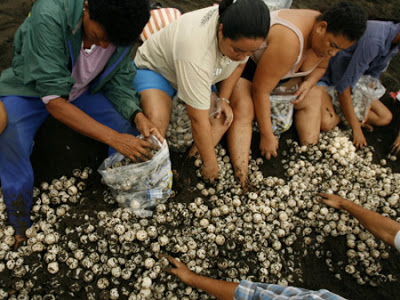

we would be sent to prison for doing this but huggers will turn a blind eye to scenes like this
This picture is from Costa Rica. Harvesting sea turtle eggs for consumption in Costa Rica is legal.

I think some of the people south of us consider the eggs an aphrodisiac.
Umm, I wonder how I could get a bag!
During a visit to Hatteras I was told about how "environmentalists" lined the beach to watch a nest of Leatherback Turtle hatchlings make their way to the ocean. They watched as seagulls ate EVERY one of the endangered turtles because it was part of nature's cycle. Apparently people are not part of that cycle.
During a visit to Hatteras I was told about how "environmentalists" lined the beach to watch a nest of Leatherback Turtle hatchlings make their way to the ocean. They watched as seagulls ate EVERY one of the endangered turtles because it was part of nature's cycle. Apparently people are not part of that cycle.
I heard that rumor as well, but I have witnessed in person the exact opposite. Volunteers associated with a multiple state, federal, and non-profit groups ensured safe travel of hatchlings to the water.