SWC Forums
Pull up a chair...let's talk fishing.

Why is there all of this discussion about oil drilling off of NC? Don't we supposedly have more natural gas than oil off of here? What happens if you have a natural gas "spill"?
What a joke. Half of NC would wither and die without money spent directly and indirectly by the federal government.
You are correct, and the lions share of them were Obama voters.
Nope. The lions share would be the people that have no clue that they have jobs because of the money spent directly by the federal government or indirectly throught their employees. Jacksonville and Fayetteville would pretty much implode. The contractors from Wilmington and Morehead City that do work on the bases would dissapear. Ft. Bragg, Camp Lejune, Cherry Point, Sunny Point, and every coast guard station and all thier employees would dissapear. Restaraunts, gas stations, gun shops, car dealerships, tattoo shops, barber shops, pawn shops, grocery stores, malls, all would disappear and the jobs they provide as well. Lots of inlets would simply fill in due to lack of funding for dredging. The port in Wilmington would close due to companies having to deal with customs trying to get their products in the US. It would be much easier to ship to VA or SC. That is just the tip of the iceberg. Good luck with that.

Looks like the straps57 has found a way to compare
maintaining our US Military as required by the Constitution
to supporting a bunch of worthless bums.....

There was an article on foxnews this morning about dolphins being killed in the gulf by gunshots etc. In this article there was more than one mention of DEAD ZONES in the gulf as a result of the oil spill. You guys are okay with Dead zones caused by oil spewing into the ocean? It's the exact same thing as an MPA. Who's to say they wont use a minor spill to create MPAs in the future? I would say that's a slam dunk! They use any excuse they can find now.
Above is a story about a real cure (at least a partial one) to our energy problems that works, that doesn't make a mess, and that is made right here in the US with the potential to be a real job creator. We figured out how to make oil work in every facet of our lives in a very short time during the industrial revolution. We need another industrial revolution with the Sun as it's fuel. With the ocean as it's fuel. An all free, easy to harness, and most importantly NEVER-ENDING source of energy that we could harness and then sell to the whole world putting the US back on top. Everyone knows oil is running out. Even if we have a projected 500 years worth under us, it is finite. Look to what is infinite and what does our future generations a solid, instead of handing them our problems HOPING they will figure it out in time.
It makes me think of how the last hold-out cavemen must have argued against the wheel while dragging their sleds through the mud. They probably had mad jokes about the dummies thinking they could roll their stuff around. :chin:
It makes me think of how the last hold-out cavemen must have argued against the wheel while dragging their sleds through the mud. They probably had mad jokes about the dummies thinking they could roll their stuff around
Actually, your post reminds me of the same alarmist
mentality the "Whale Oil Worriers" had in 1800's.
"Dis whale oil gonna run out and we'll all freeze"
:lmao:
Drill baby drill :wtg:
Looks like the straps57 has found a way to compare
maintaining our US Military as required by the Constitution
to supporting a bunch of worthless bums.....
And it looks like you missed the point entirely.
Please, stop trolling. We are attempting to have a serious discussion.
Drill baby drill :wtg:
Quoting Sarah Palin huh? Man, I'm fighting a losing battle. She was neighbors with Russia you know? You betcha!
You'll get what your'e after, they'll be drilling baby drilling in no time.
Get used to the pic below. Is that reds tailing in the waves?? No that's red waves..... :wall: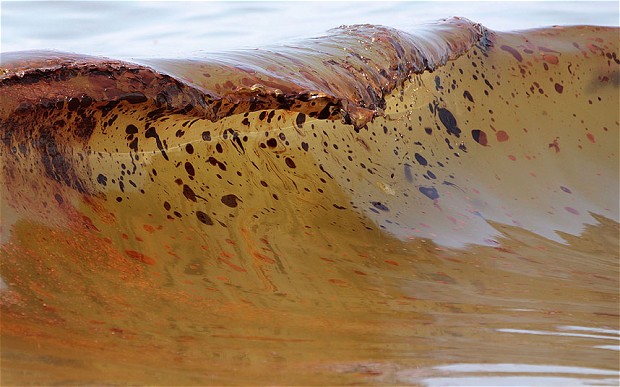
http://seawifs.gsfc.nasa.gov/OCEAN_PLANET/HTML/peril_oil_pollution.html
Tanks for the "Greenpeace" pic of oily wave,
As with any reward, there is risk.
Are you aware nature releases at least
62 million gallons of oil in our seas every year ?
'course no concern of yours in "Eric13 world",
"Earth will run out any day now"
🙄
http://seawifs.gsfc.nasa.gov/OCEAN_PLANET/HTML/peril_oil_pollution.html
Tanks for the "Greenpeace" pic of oily wave,
As with any reward, there is risk.Are you aware nature releases at least
62 million gallons of oil in our seas every year ?'course no concern of yours in "Eric13 world",
"Earth will run out any day now"
🙄
Okay, I get it. I'll shut up. Dont matter who took that pic, it's real and it wasn't a natural eruption. In eric13 world, all is well. Notice, I said 400-500 years worth, not tomorrow. I am realistic about it. Just dont like playing on a losing team. You are right, with any reward there is risk. The risk is worth it to all of you, and to me not so much. A thousand shrimp boats dragging the beach in tight lines over and over will do nothing compared to an oil spill. "Sportsmen" cant handle the risk of a few shrimp boats, but the risk of a goo marsh is quite acceptable. I just think it's funny thats all. I dont think ANY of you are gonna change their minds over something I said, but I will still give my .02. I'll sign off now, before it gets ugly. I've said my piece.
Did nature clean up most of the Exxon Valdez oil spill?
June 18, 2010
Dear Cecil:
The current drama over the gulf oil spill reminds me of an article some years ago saying that, despite millions spent on massive coastline cleanup following the Exxon Valdez disaster, contaminated areas untouched by cleanup crews reverted to their pristine pre-spill condition just as quickly as those with human help. Is this a case of letting Mother Nature alone to do what she does best, or simply not true?
— Mike Hogan, Auckland, New Zealand
Cecil replies:
Apparently the good news hasn't gotten out to kiwi country. Rush Limbaugh has already assessed the situation in the Gulf of Mexico and announced, "The ocean will take care of this on its own if it was left alone and was left out there. It's natural. It's as natural as the ocean water is. Well, the turtles may take a hit for a while, but so what?" Still, maybe you won't mind getting a second opinion from me.
The basics: First, oil is mostly biodegradable. Some of it evaporates or breaks down with exposure to sunlight, and at least 20 types of marine bacteria plus several types of fungi can degrade what's left. Surprised to learn that bacteria eat oil? Don't be. Although oil spills from tankers and wells make the news, they account for less than 15 percent of the total petroleum entering the world's oceans, while 47 percent comes from natural oil seeps. (The rest largely comes from petroleum use.)
That doesn't mean oil biodegrades easily. Crude oil consists mainly of various types of hydrocarbons, some of which break down readily, others not at all. Light oils generally degrade faster than heavy ones. Very light crude might lose 60 percent of its volume due to biodegradation in four weeks, heavy crude just 10 percent. Temperature is important — warmer waters encourage bacteria growth, which is one bright spot for the gulf.
A big factor slowing oil breakdown is that oil doesn't contain much nitrogen or phosphorus, both of which are needed for good bacterial growth. Enter bioremediation, where fertilizer is added to encourage natural bacteria. First tried in the 1960s, it evidently works. One 2002 study showed that adding just 0.25 percent fertilizer to oil on a lab-simulated beach quintupled the natural biodegradation rate. Tests in 1994 in Delaware Bay, which is already rich with bacterial nutrients, showed fertilizer doubled the rate of oil degradation in shallow waters. The same year, scientists fighting a spill on a beach near Haifa, Israel, reported that bioremediation had reduced oil contamination 88 percent in just four weeks.
Sometimes nature doesn't need much assistance. Following the 1978 wreck of the Amoco Cadiz off the coast of Brittany, oil was broken down quickly by local microbes, which had grown accustomed to the stuff thanks to shipping leakage. Same for the 1980 Tanio wreck in the same area — biodegradation was detectable within 24 hours. The blowout of the Ixtoc well in the Gulf of Mexico in 1979 was a different story. Warm water and friendly bacteria raised hopes for speedy degradation, but in this case the oil formed an emulsion, or mousse, on the surface that proved resistant to breakdown.
To your question: It's true that human efforts didn't clean up most of the 1989 Exxon Valdez spill. Some hydrocarbons degraded rapidly without assistance, possibly because bacteria in Prince William Sound had acclimated to resin emitted by pine trees on shore.
But bioremediation seemed to help. Local bacteria were found to be starving for nutrients, and once fertilizers were added to a test area they got busy. Within a couple weeks a “white window” of clean rocks appeared among the gunk-covered ones. Eventually more than 70 miles of beach were treated this way.
Later researchers questioned how much oil the process actually got rid of, though. It's been calculated that all told, bioremediation, skimming, spraying, and scrubbing were responsible for removing less than a sixth of the spilled oil. Who or whatever deserves the credit, most of the Exxon Valdez spillage did eventually disappear.
Not all of it, though — biodegradation has its limits. Oxygen is key in much bacterial action, and once oil gets buried under sediment things really slow down. In 2001 researchers dug pits at 91 sites along the shore of Prince William Sound and found oil at roughly three in five. That may sound overly grim — another survey of 5,000 pits by U.S. government researchers in 2001 and 2003 found 98 percent had little or no oil.
Conclusion? Let’s break this down into more digestible bits. Do oil spills mostly go away on their own? Yes. Does that mean we’re better off leaving them alone? Of course not. Nobody doubts we need to plug leaks and contain spillage, and I’m persuaded bioremediation helps at least sometimes.
But other intervention may be wasteful or harmful. Excessive use of chemical dispersants may threaten wildlife. Animal rescue efforts may be expensive PR exercises. The chief lesson from past spills is how little we know about what works. We’d better find out.
Just happened on the 15th:
"This is the worst spill in this community since Exxon started its operations in the area," said Edet Asuquo, 40, a fisherman in the Mkpanak community, as women scooped oil into buckets. In some marshy areas, plants were poking out of the slick, not yet dead and blackened by the oil.
"The fishermen cannot fish any longer and have no alternative means of survival," Asuquo said.
another survey of 5,000 pits by U.S. government researchers in 2001 and 2003 found 98 percent had little or no oil.
http://en.wikipedia.org/wiki/Exxon_Valdez_oil_spill
For you Carolina Fans:
"Some twenty years after the spill, a team from the University of North Carolina found that the effects were lasting far longer than expected.[27] The team estimates some shoreline Arctic habitats may take up to thirty years to recover. The spill occurred on March 24, 1989."
lol.....
The Valdez oil spill happened in 1989 brah.
Im glad that 15 years later 98% were good to go!
I wonder what MHC, AB, Emerald Isle, Beaufort look like 15 years after a oil spill shuts down commercial/rec fishing and tourism for a decade?
Anyone care to take a guess?
"According to several studies funded by the state of Alaska, the spill had both short-term and long-term economic effects. These included the loss of recreational sports, fisheries, reduced tourism, and an estimate of what economists call "existence value", which is the value to the public of a pristine Prince William Sound"
"The economy of the city of Cordova, Alaska was adversely affected after the spill damaged stocks of salmon and herring in the area. Several residents, including one former mayor, committed suicide after the spill"
Oil major BP Plc this week agreed to pay $4.5 billion in penalties for spilling nearly 5 million barrels of oil into the Gulf of Mexico. Despite thousands of barrels a year spilt by oil majors in Nigeria, none has ever been forced to make a financially significant settlement.
🙄 ...more liberal obstructionism....every year Mother Nature
releases over 62 million barrels of oil in our oceans.
I wonder what MHC, AB, Emerald Isle, Beaufort look like 15 years after a oil spill shuts down commercial/rec fishing and tourism for a decade?
...and I wonder how our coastal economy will survive after 4 more
years of closed fishing areas, high gasoline costs, escalating boat (read fiberglass) costs...not to mention a healthcare tax set to bankrupt us all.
"Is a pristene shoreline a pristene shoreline if no one can afford to see it?"

When is the last time you looked at a Marine Chart of Onslow Bay?
How many tankers went down FULL....during WWII
Gill, Nashville, Papoose, Neaco come to mind right off the top of my head....
There are MANY MANY more....
No worries.
Dave
:lmao: