

SWC Forums
Pull up a chair...let's talk fishing.

I have a 21' Coastal Skiff tunnel hull with a 90 horse Nissan. Going to slap a new engine on her in the somewhat near future and would like to upsize a little bit to maybe a 115. There's a placard on the hull stating the boat is rated for a 90hp. My questions are...
How is this rating arrived at? Is it weight based? Or transom thickness? Anyway, curious if anyone has knowledge about these ratings and what I might could do to get the rating increased. She's a great solid boat, just slow and feels underpowered. If I go back with another 90, should I go 2 stroke or 4? Any suggestions or feedback is appreciated!
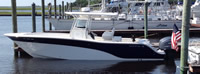
I had a Yamaha HPDI (2 stroke) and it was a good engine. I now have Yamaha 4 strokes and no way would I go back to a 2 stroke. Much quieter. Great engines!

For speed go 2-stroke. The rating is based on transom strength and weight. A heavier engine changes the balance point of the boat. As far as I know you can put a higher hp motor on there but might have trouble insuring it.

Regardless of the engine you choose, spend the money and put a powered Jack Plate on her. I have a tunnel hull skiff and I wish I would have installed a jack plate so that I could get the most out of the shallow water capability of the hull. There have been a few dozen times I wish I could have gotten the engine 4" higher. A bow mount trolling motor is definately in my future.
Motor size limits are based on both structural strength of the transom versus horsepower and the weight (ironically when out of the water) because the transom see's maximum stresses in three scenarios: Hole shot, hitting something with the submerged engine when under power and when trailering and hitting a bump in the road. Hole shot is the lesser of the three stresses. Trailering an unsupported engine probably does more subtle damage than anything so get an engine support yoke if you trailer. Chances are excellent that your skiff will handle a 115 as far as a hole shot goes. I'd be most concerned about engine weight in the event that you hit a submerged object. All of the rotational torque generated by hitting a submerged object is transferred to the transom in a twisting motion trying to shove the transom forward and down at the moment of impact. The heavier the motor, the higher the instantaneous torque so check with the manufacturer. They might recommend something as simple as a reinforcing plate to handle the extra load.
Good luck.
I respectfully disagree about the 2 strokes being more powerful. I think the difference is minimal. There is a youtube video of a Yamaha vmax (2 stroke) vs a Yamaha SHO (4 stroke) on identical boats. The SHO 4 stroke out accelerated and out ran top side the stroke. I think that 2 stroke vs 4 stroke opinion is dated and should only be used on first generation 4 stroke engines. Modern 4 strokes are awesome!
Its not more powerful. 2 strokes are lighter. Lighter weight = Higher speed.
I love 4 strokes, but a lighter 2 stroke will always be faster if propped correctly.
Yamaha 200 HPDI 2 stroke weight - 475 lbs
Yamaha 225 4 stroke weight - 562 lbs
I will gladly sacrifice 87 lbs not have to fill and mess around with an oil reservoir. I will also give up that weight to have engines that can barely be heard when idling.
Unless you are hanging your engine on a kayak, I would give up the small increase in weight.
If you go 2 stroke just know that it will reduce the resale value of your boat if you choose to sell it because they are becoming a thing of the past.
I appreciate the feedback and varying opinions. My current setup runs very skinny. I frequent Core Sound and Drum Inlets so running skinny is a must. I believe the manufacturer was the now defunct Princess Marine out of Havelock so consulting them isn't an option. The current engine does not sit flush on the top of the transom. There's a 2-3" gap between the top of the transom and the motor brackets meaning all the engine weight is on the 4 thru bolts. Whomever powered it before I bought it set it up that way so she would run skinny. 2 questions, is my current setup really wrong and if so would a jackplate correct it?

and what I might could do to get the rating increased.
Pretty sure your max rating is determined by the manufacturer. If they tell you the 115 is OK, ask for that in writing. It's a potential liability thing, for them and you ... :chin:
I agree with Curmudgeon. It's a liability. I would not mount an engine that exceeded the USCG max HP. Just my 2 cents.