SWC Forums
Pull up a chair...let's talk fishing.

This will not go through the full council as I understand it.
Roy Crabtree can all by his corrupt self, approve this "pilot" and award his buddies exclusive access to our resource
CFSF can correct me if I am wrong
this is the most serious assault on our fisheries we have been subject to so far. This is far more serious than a 2 fish reduction in flounder or a season closure on cobia. This is an allocation scheme that will transfer ownership from the people to the companies that will gladly sell you back your fish

Yes, NOAA Regional Fisheries Administrator Dr. Roy Crabtree has the final say on whether the pilot catch share EFP is approved.
However, Dr. Crabtree is seeking the advice of the SAFMC at their meeting next week as to whether the EFP application should move forward or not. If the SAFMC takes a strong position against the EFP, I believe it would be difficult for Dr. Crabtree to then approve the application.
If Dr. Crabtree moves the application forward, a notice it would be published in the CFR and a 45-day public comment period to NOAA would start.
Here are another couple of links illustrating how this crap works.
http://www.al.com/news/index.ssf/2016/04/post_111.html
http://fisherynation.com/archives/tag/catch-shares
https://www.foodandwaterwatch.org/in...at-catch-share
This resolution, H. 3856, was introduced yesterday in the SC House of Representatives.
Our thanks to Reps. Lee Hewitt, Jay Jordan, Alan Clemmons, Richie Yow, Roger Kirby and Phillip Lowe for standing up for fishermen and fishing communities.
A HOUSE RESOLUTION
TO OPPOSE THE PRIVATIZATION OF SOUTH ATLANTIC FEDERAL FISHERY RESOURCES THROUGH CATCH SHARE MANAGEMENT AND EFFORTS THROUGH EXEMPTED FISHING PERMITS OR OTHER MEANS TO CONDUCT PILOT CATCH SHARE PROGRAMS OR STUDIES.
Whereas, "catch share" is a term for fishery management strategies that allocate a specific portion of the total allowable fishery catch to individuals or other entities, effectively giving private ownership of federal fishery resources to individuals and corporations; and
Whereas, in 2010, the National Oceanic and Atmospheric Administration (NOAA) Fisheries adopted a national catch share policy, which states that "NOAA encourages the consideration and adoption of catch shares wherever appropriate in fishery management and ecosystem plans and their amendments, and will support the design, implementation, and monitoring of catch share programs"; and
Whereas, private ownership of federal fishery resources through catch share programs nationally has caused significant consolidation of fishing fleets, reducing access to the resource and causing significant fishing job losses to the detriment of fishing communities and the coastal economy; and
Whereas, a 2013 report by the Center for Investigative Reporting provides estimates that as many as eighteen thousand fishing jobs were lost and three thousand seven hundred vessels were no longer fishing in areas that had catch share programs, with those numbers being likely much higher now; and
Whereas, this year, a WVUE-TV, New Orleans, investigative report into the Gulf of Mexico commercial red snapper fishery catch share program stated that just "fifty businesses and fishermen control eighty-one percent of the commercial red snapper allocation," causing many fishermen to lose access to the fishery or forcing them to pay exorbitant prices to buy or rent red snapper shares so they can remain employed in the fishery; and
Whereas, a 2013 NOAA study of the impacts of catch shares on southern New England fishermen and families found that seventy percent said they were "worse/much worse off" with catch shares; and
Whereas, fishery stakeholders in South Carolina and the South Atlantic are overwhelmingly opposed to catch share programs in federal waters as evidenced by ninety-seven percent of the comments on the South Atlantic Fishery Management Council's long-range snapper-grouper fishery management plan being opposed to any form of catch shares; and
Whereas, studies by the Lenfest Ocean Program and reports by Food and Water Watch and others have shown that catch share programs provide no biological benefit or enhanced sustainability to fisheries; and
Whereas, saltwater fishing is economically very important to South Carolina, with recreational and commercial fishing in 2014 generating $545.4 million and $74.3 million in sales and supporting six thousand two hundred and one thousand four hundred jobs respectively, according to NOAA. Now therefore,
Be it resolved by the House of Representatives:
That members of the House of Representatives, by this resolution, oppose the use of catch share fisheries management in federal waters off South Carolina and in the South Atlantic, and any efforts through exempted fishing permits or other means to conduct pilot catch share programs or studies.
Be it further resolved that a copy of the resolution be forwarded to the South Atlantic Fishery Management Council, NOAA Fisheries and the South Carolina Department of Natural Resources.
----XX----
http://www.scstatehouse.gov/sess122_2017-2018/bills/3856.htm
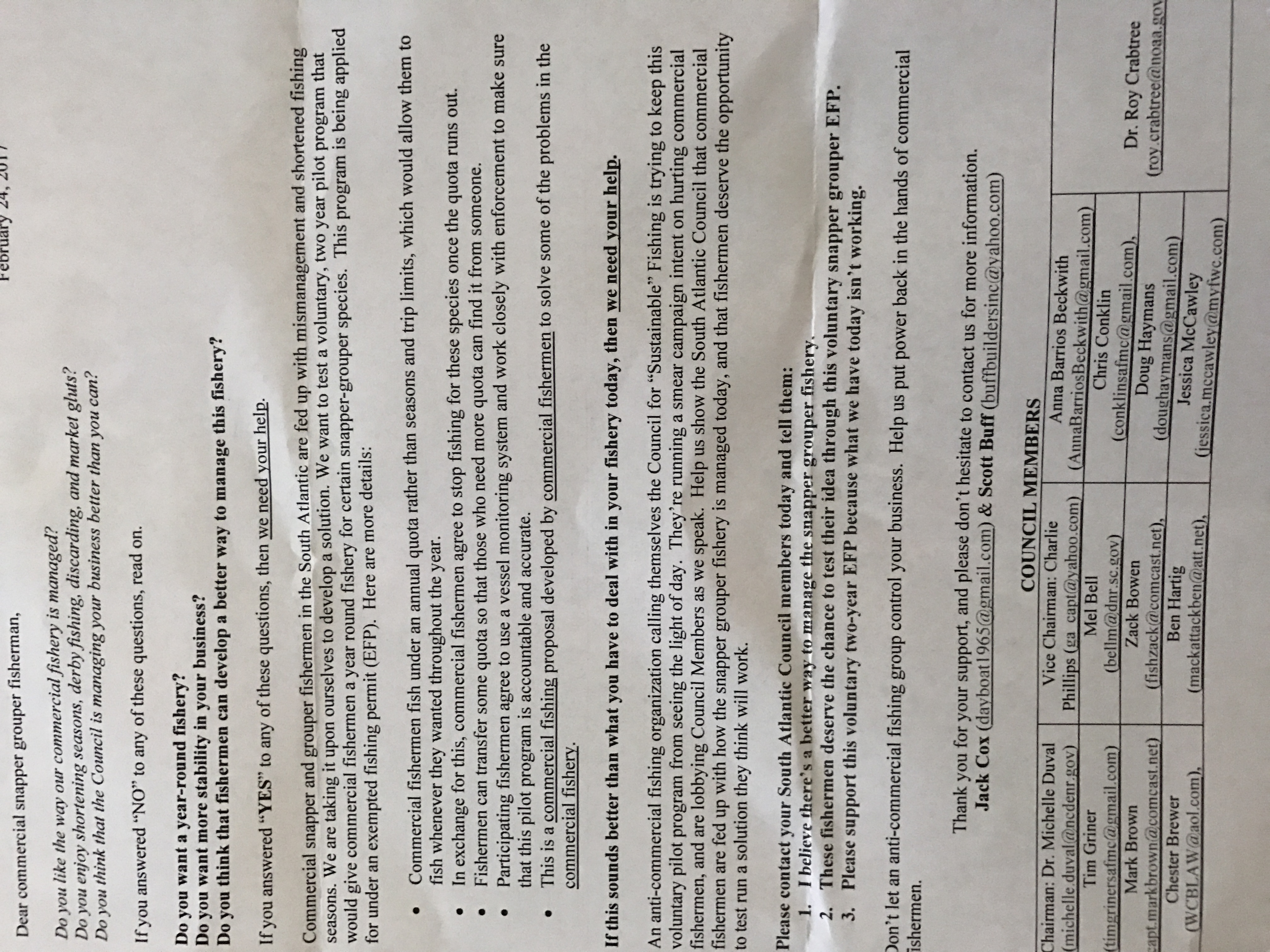
Just received an interesting letter from the South Atlantic Commercial Fishing Collaborative claiming the CFSF is "an anti-commercial fishing organization".
Just received an interesting letter from the South Atlantic Commercial Fishing Collaborative claiming the CFSF is "an anti-commercial fishing organization".
Isn't this the group that took over $200K from EDF to support catch shares?
Just received an interesting letter from the South Atlantic Commercial Fishing Collaborative claiming the CFSF is "an anti-commercial fishing organization".
Isn't this the group that took over $200K from EDF to support catch shares?
Yes, they just changed their name. It was the South Atlantic Fishermen's Ass.
http://www.southerncatch.com/
If they are supporting catch shares after taking money to change their position, then they are the ones who are anti commercial fishermen because they are the ones that now support a policy that will put a significant number of fishermen out of business
Hypocrisy at its finest
If they are supporting catch shares after taking money to change their position, then they are the ones who are anti commercial fishermen because they are the ones that now support a policy that will put a significant number of fishermen out of business
Hypocrisy at its finest
They didn't change their position, just the name. EDF gave them the money to create organizations and advertise how great catch shares are.
Check out their advocacy positions.
http://www.southerncatch.com/resources/Advocacy-Positions/
Myrtle Beach SUN NEWS: Controversy brewing over Exempted Fishing Permit
By Gregg Holshouser - March 3, 2017
A storm is brewing in the South Atlantic region, a storm of controversy over snapper-grouper fisheries access and allocation.
A group of four commercial fishing businesses – the South Atlantic Commercial Fishing Collaborative – filed an Exempted Fishing Permit (EFP) application with the National Marine Fisheries Service on Feb. 6.
If approved by NMFS, the EFP would allow a group of 25 snapper-grouper boats operated by the four businesses to harvest blueline tilefish, gag grouper, gray triggerfish, greater amberjack, vermilion snapper and species in the jacks complex for two years (2018-19) in a pilot program while being exempt from numerous fishing regulations.
The generic name for such a fisheries management method is catch shares, which, according to NOAA Fisheries, is a program in which “a portion of the catch for a species is allocated to individual fishermen or groups. Each holder of a catch share must stop fishing when his/her specific share of the quota is reached.”
But it is a concept the huge majority of saltwater fishermen – recreational fishermen and small commercial fishing operations – have proven to be vehemently opposed to.
The South Atlantic Commercial Fishing Collaborative is trying to help its snapper-grouper fishing operations get away from short, derby-style fishing seasons, which it says creates quota overages, numerous fish discards and marketplace instability that results in fluctuations in price.
Opponents say the EFP application is unfair privatization of public marine resources, and a bevy of opposition to the proposal has arisen on the local and state level in South Carolina.
The South Carolina House of Representatives on Thursday issued a resolution against the use of catch shares in the South Atlantic Region, a move that was quickly praised by Coastal Conservation Association South Carolina.
“Coastal Conservation Association is opposed to the concept of catch shares, particularly in mixed-use fisheries in which there is both recreational and commercial participation,” said Scott Whitaker, executive director of the South Carolina chapter of CCA.
“We truly appreciate these efforts by our local elected officials because, though public opposition to these privatization polices has been overwhelming and vocal, the federal management system has routinely ignored our objections.”
Brad Dean, President and CEO of the Myrtle Beach Area Chamber of Commerce, on Tuesday sent a letter to Greg Waugh, Executive Director of the South Atlantic Fishery Management Council, stating the MBACC Board of Directors unanimously voted to oppose the EFP.
Marc Jordan, President and CEO of the North Myrtle Beach Chamber of Commerce, posted his organization’s opposition to the EFP on a comments section of the SAFMC website.
Two of the four businessmen listed on the EFP Application are members of the South Atlantic Fishery Management Council, which will address the issue at next week’s council meeting, set for Monday through Friday in Jekyll Island, Ga.
Chris Conklin of Murrells Inlet, owner of Seven Seas Seafood, and Charlie Phillips of Townsend, Ga., owner of Phillips Seafood and Sapelo Sea Farms, are both on the council.
Phillips is the council’s vice-chairman while Conklin is one of three South Carolinians on the council, holding the state’s obligatory seat.
The other two businessmen in the collaborative are Jack Cox, of Morehead City, N.C., owner of Crystal Coast Fisheries and co-owner of Blue Ocean Market, and Scott Buff of Oak Island, N.C., who operates a number of snapper-grouper commercial fishing boats. Cox held an at-large seat on the SAFMC from 2013-16.
Conklin and Cox on Friday expressed the issues facing the snapper-grouper commercial fishing “bandit boats” they operate that pushed them to move forward with the application.
“What we’re interested in is to have access to the fishery throughout the year, year-round, (but) still respecting our spawning season closures,” said Cox. “All we want to do is to catch what we’ve been catching historically in proportion to what we were going to catch (during a year) anyway. We just want to be able to access that fishery when we feel like it’s best for our fishermen and best for the consumer.”
Conklin is unhappy with the effect he feels current fisheries management has on snapper-grouper commercial fishing in the South Atlantic region.
“Current (fisheries) management is about to force us to go out of business here,” said Conklin. “We’re on the threshold of profitability for the traditional type (snapper-grouper) boats. If we keep going down this road of mismanagement that we’re under, it’s going to make our equipment obsolete.”
Cox added “we’re commercial fishermen, we’re businessmen, we’re just trying to figure out how to stay in business because existing management is kicking us to the curb.”
Conklin expects the SAFMC to address the issue on Thursday afternoon at the council meeting, set for The Westin Jekyll Island in Jekyll Island, Ga.
“We’ve already spent thousands and thousands of dollars to get this far (with the EFP application) and all we’re asking for is people not to come to public comment and raise hell and say ‘we don’t want this,’ ” said Cox. “You get to a better place when you say ‘I don’t agree with what you’re doing, I don’t like what you’re doing but here’s what I suggest.’ That’s what we’re asking for.”
Fishermen wishing to comment on the issue can find a public comment form and view a meeting agenda at www.safmc.net/safmc-meetings/council-meetings/.
http://www.myrtlebeachonline.com/sports/outdoors/article136360228.html#storylink=cpy
Here are a bunch of contacts to email and call. If I remember right March 9 is the deadline for comment.
'http://safmc.net/contact-us/
Gov. Roy Cooper - http://governor.nc.gov/contact-governor-cooper
Sen Thom Tillis - https://www.tillis.senate.gov/public/index.cfm/email-me
Sen. Richard Burr - http://www.burr.senate.gov/contact/email (202) 224-3154SAMFC committee:
Vice Chair Charlie Phillips -- ga_capt@yahoo.com or 912-832-4423
Chris Conklin -- conklinsafmc@gmail.com or 843-543-3833
roy.crabtree@noaa.gov
jessica.mccawley@myfwc.com
mackattackben@att.net
WCBLAW@aol.com
doughaymans@gmail.com
fishzack@comcast.net
capt.markbrown@comcast.net
bellm@dnr.sc.gov
timgrinersafmc@gmail.com
AnnaBarriosBeckwith@gmail.com
michelle.duval@ncdenr.gov
Please consider sending an email to individual council members politely asking them to vote against the EFP application. This is likely to be a close vote that could come down to changing one mind.
Here is the letter I got from them .